






The daily operations of an industrial facility are frequently characterized by operational urgency. At the start of a shift, production managers often encounter piles of printed reports, manual logs, and disjointed spreadsheets reflecting past performance, with little indication of real-time optimization opportunities. When an unexpected equipment breakdown occurs, the entire operational routine is suspended to execute emergency repairs, the standard industry struggle of “firefighting.” This reactive loop drains the energy of operational teams, leaving minimal time to plan strategic improvements or optimize the production line.
To manage this operational overload, sophisticated paradigms like Industry 4.0 often seem distant to factories that are still grappling with the basic challenge of maintaining legacy assets in working order. However, this perceived gap rests on a common misconception of what process digitalization actually entails. Digitalization is not merely the conversion of paper records into digital spreadsheets, nor is it the basic replacement of clipboards with mobile tablets.
True industrial digitalization centers on the automated, real-time collection of operational data directly from the factory floor, seamlessly connecting sensors and programmable controllers to enterprise management and decision-making systems. It involves translating physical operational variables, such as temperature, vibration, velocity, and energy consumption, into actionable intelligence that drives efficiency, predictability, and structural cost reduction.
The invisible cost of technological lag
Maintaining legacy infrastructure under the assumption that “if it is working, do not touch it” can obscure a silent, compounding financial burden. Industrial operations in mature economies, particularly in the United States and the United Kingdom, face a critical challenge regarding the aging of their physical assets.
According to data compiled by the United States Bureau of Economic Analysis (BEA), the average age of manufacturing equipment in active operation is close to 20 years, representing a near-doubling of asset age since 1990. This capital aging is particularly acute for plant infrastructure; for example, while the average U.S. factory was 16 years old in 1980, its average age reached 25 years by the late 2010s.
The operational scenario becomes increasingly vulnerable when analyzing the condition of these assets. Approximately 40% to 50% of the active manufacturing equipment base requires major upgrades or outright replacement to accommodate contemporary digital components, such as Internet of Things (IoT) sensors and modern analytical software.
Furthermore, legacy machinery remains deeply embedded on the factory floor, with decision-makers estimating that 29% of factory equipment in the United States and up to 31% in the United Kingdom consists of legacy assets. Many of these machines, manufactured in preceding decades, operate as digital islands. They run on isolated, analog architectures with no native capacity to interface with modern enterprise platforms, driving up maintenance costs and restricting overall plant competitiveness.
Regarding the integration of advanced technologies, major implementation gaps persist across the industrial sector. For example, surveys indicate that only 16% of manufacturers have established a fully defined, comprehensive Industry 4.0 strategy, and a mere 28% of enterprise applications are actively integrated with one another.
Although up to 69% of industrial firms report using some form of digital tools, the vast majority operate these solutions in functional isolation, typically employing only one to three disconnected technologies without unified communication. This lack of integration prevents organizations from achieving a cohesive, real-time view of their manufacturing environment.
The operational consequences are direct and measurable. Legacy machinery incurs high corrective maintenance expenses, and as parts face obsolescence, securing replacements becomes a slow, expensive endeavor. This results in extensive unplanned downtime, which severely compromises overall equipment effectiveness. For instance, in sectors like the United Kingdom, a third of manufacturers report that the typical cost associated with a downtime incident stemming from unreliable legacy equipment falls between £10,001 and £25,000.
Resistance to modernization is frequently tied to implementation challenges, such as the high cost of deployment, a severe shortage of skilled technical labor, and difficulty demonstrating short-term business cases to justify underlying IT/OT infrastructure investments.
The following comparative analysis details these critical metrics and their operational consequences:
| Indicator | International benchmark | Operational impact |
| Average Age of Assets | Close to 20 years (US) | Declining asset productivity, progressive operational downtime, and escalating maintenance costs. |
| Assets Requiring Digital Upgrades | 40% to 50% of active equipment base (US) | Inability to support modern IoT sensors or analytics, leading to persistent capital obsolescence. |
| Legacy Machinery Prevalence | 29% (US) / 31% (UK) of factory machinery | Isolated operations with zero real-time data visibility, leading to high downtime cost exposure. |
| System Integration Deficit | Only 28% of enterprise applications integrated | Proliferation of disconnected data silos, limiting the capacity to scale advanced analytics and AI. |
Read more: What Is Industry 4.0 and Why Is It Such A Challenge For Legacy Manufacturing Systems?
Modernization is not an all-or-nothing proposition
Faced with these challenges, many operations managers conclude that industrial digitalization demands massive, multi-million dollar investments, a complete overhaul of physical machinery, or extensive production shutdowns that would jeopardize immediate revenues. However, this binary view of modernization is a misconception. Gradual technical evolution through digital retrofitting demonstrates that mechanically sound, legacy assets can be converted into connected devices without requiring decommissioning.
Through the strategic installation of Industrial IoT (IIoT) sensors, compact programmable logic controllers (PLCs), and edge gateways, older machinery can be retrofitted to collect and transmit real-time performance, operating state, and energy consumption data. This brings isolated equipment into the factory’s digital ecosystem, expanding operational visibility and enabling faster, more accurate decision-making.
Empirical studies consistently demonstrate the viability of this incremental path. For example, researchers analyzed a legacy CNC milling machine that had been in continuous service for over 20 years in Brazil. By integrating low-cost smart sensors and cloud-connected IoT gateways, engineers successfully monitored and analyzed the machine’s electrical energy consumption in real-time, all without disrupting its primary mechanical operations.
This underscores a key advantage of digital retrofitting: its highly optimized cost-to-value ratio compared to capital asset replacement. While procuring a new, large-scale industrial machine may require investments of hundreds of thousands or even millions of dollars, retrofitting existing assets with smart sensors and edge connectivity devices typically costs only a small fraction of that amount.
In fact, the market for retrofits for legacy equipment is expanding rapidly, projected to grow from $2.3 billion in 2026 to $6.1 billion by 2036 at a annual growth rate of 10.3%, highlighting the global shift toward cost-effective equipment modernization. Within this domain, predictive maintenance and monitoring dominate the retrofit functional applications with a 41% market share, directly addressing the primary pain point of legacy operations.
The recommended engineering practice is to initiate the digitalization roadmap gradually, concentrating resources on a single production cell or a specific operational bottleneck. The quantifiable gains achieved during this pilot project provide a practical demonstration of the return on investment. In many cases, the cost savings and efficiency gains generated by the initial phase are used to fund the expansion of the digital platform to other lines of the facility.
The viability of incremental technological adoption is further supported by government-backed initiatives like the United Kingdom’s Made Smarter program, which has supported over 2,500 manufacturing small and medium-sized enterprises in deploying digital solutions. Early evaluations of its North West pilot program showed that 84% of participating firms experienced a significant increase in productivity, delivering an average 6.5% growth in turnover and a 3.9% increase in employment compared to non-participating peers.
Another critical technical consideration is the adoption of technologies compatible with open, industry-standard communication protocols, such as MQTT, Modbus, and OPC UA. This mitigates dependence on proprietary software, restrictive licenses, and single-vendor lock-in. Consequently, the shop floor can communicate dynamically with supervisory platforms, cloud databases, and data analytics tools, providing the enterprise with maximum scalability, integration flexibility, and minimized long-term maintenance costs.
Learn more about the role of communication protocols in digital transformation: The transformation of industries in the era of artificial intelligence
Practical architecture for industrial modernization
Let’s look at a practical example: imagine a feed factory in the 1980s operating at full production pace. The environment was dominated by large mechanical machines, the constant noise of motors, and operators moving from one side to another to perform essentially manual controls, in some cases through large electrical panels and, in others, even using cranks and mechanical adjustments.
In this scenario, the operation revolved around three main pieces of equipment: the grinder, the sieve, and the mixer. The grinder was responsible for crushing the grains using motors and belt systems, requiring constant visual monitoring by the operator to prevent failures or over-grinding.
Next, the sieve separated the material according to particle size. Its operation was based on mechanical vibration, while adjustments and regulations were made manually, according to the experience of the operational team.
Finally, the mixer blended the feed ingredients. The mixing time was often controlled “by eye” or with simple clocks, making the final quality of the product highly dependent on the perception and experience of the operator in charge.
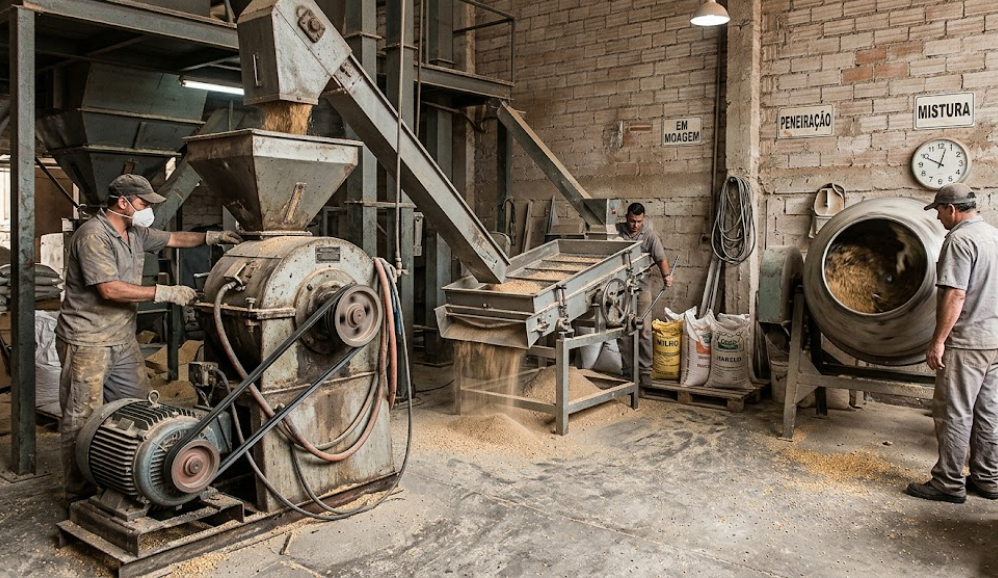
Back then, industrial technology was quite limited compared to current standards. Machines had to be started manually, often directly at electrical enclosures or simple panels, without any kind of real-time monitoring.
Fault identification also depended on the operators. Problems were noticed by the sound of the motors, the intensity of vibrations, or even the smell of equipment overheating. When a failure occurred, maintenance was performed only after the total breakdown of a component.
The entire industrial operation was sustained by the practical knowledge of the teams, the mechanical strength of the machines, and repetitive processes. It was a period when automation was still taking its first steps inside factories, and a large part of operational efficiency depended directly on shop floor experience.
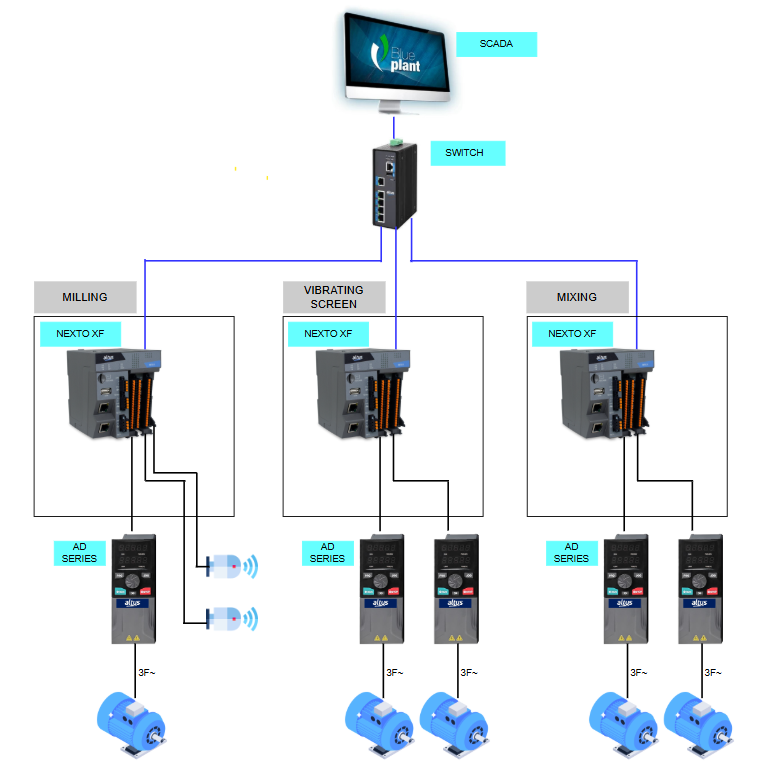
In 2026, the industrial landscape is completely different. Modern factories can operate in an integrated, connected, and automated way, with the PLC acting as the primary driver responsible for controlling and coordinating the entire operation.
Instead of relying on the manual activation of each piece of equipment, the PLC now manages the operation of the entire production line in real time. With an automation system, it is possible to initiate automatic production sequences, adjust speeds, detect faults before they happen, and even stop equipment safely in hazardous situations.
The operator stops being just someone who “turns on machines” and starts acting as a process supervisor, while the PLC guarantees precision, safety, traceability, and productivity levels far superior to those of mechanical and analog factories.
The architecture below exemplifies how a traditional industry can be modernized through digitalization:
Adaptation, connectivity, and evolution: the pathway to operational survival
Process digitalization is no longer an optional technological trend; it has become a core strategic necessity to maintain competitiveness and ensure long-term survival in the global industrial market. Relying on reactive, legacy manufacturing models, dependent on paper reports and disconnected spreadsheets, only increases operational costs, drives down productivity, and widens the competitiveness gap against digitally enabled peers.
The strategic urgency of this transition is underscored by the 2025 Deloitte Smart Manufacturing Survey, which indicates that 92% of surveyed manufacturing executives view smart factory technologies as the primary driver of industrial competitiveness over the next three years. This recognition is backed by substantial capital commitments, with 78% of manufacturers allocating more than 20% of their overall improvement budgets to smart manufacturing initiatives.
These investments yield tangible operational and financial improvements, including a 10% to 20% increase in production output, a 7% to 20% improvement in employee productivity, and the unlocking of 10% to 15% in additional plant capacity.
Fortunately, the transition to a smart factory does not require a sudden, capital-intensive replacement of the entire plant. Utilizing a planned, modular digital retrofit strategy allows legacy machines to be connected directly to enterprise intelligence and management software, maximizing the utility of installed capital assets while minimizing modernization costs. For manufacturing organizations seeking to secure market relevance and improve operational efficiency, the most reliable path begins with an objective assessment of the technological maturity of their physical assets.
Partnering with specialized automation and digital transformation providers like Altus allows industrial firms to develop a secure, scalable, and tailored modernization roadmap, effectively converting the factory floor into a source of real-time data, operational intelligence, and sustainable competitive advantage.