






The quality and reliability of any production process depend on the precise, efficient, and dynamic control of motors. In an industrial landscape that is increasingly connected and performance-driven, drive systems have evolved from simple speed control tools into strategic components of operational efficiency.
Over more than four decades, Altus has established itself within the industrial automation technology sector, participating in projects that have shaped national infrastructure in Brazil. Notable among these are the modernization of the Bianchini factories and the modernization of the Paulo Afonso Hydroelectric Complex, which is essential to the Brazilian energy matrix.
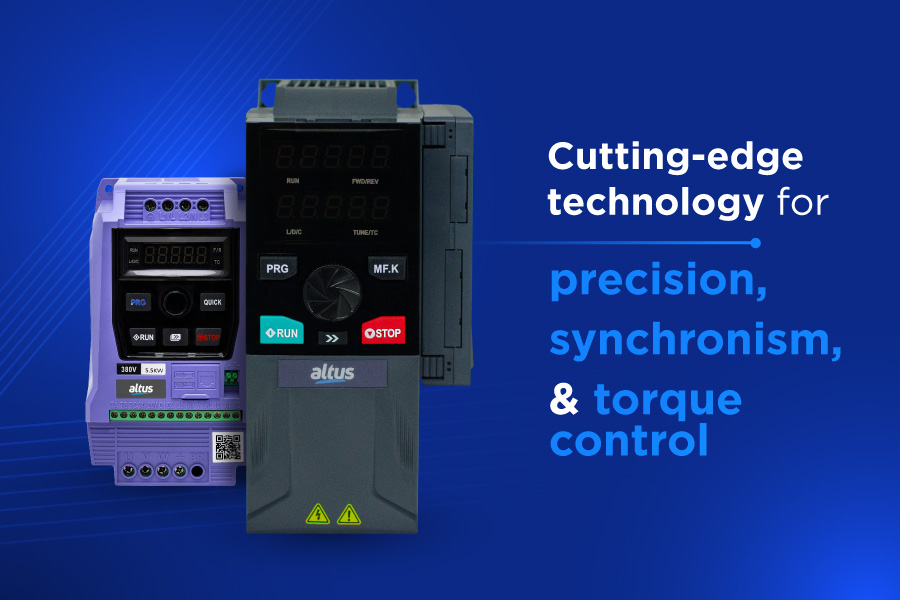
To meet the demands of an increasingly rigorous market, Altus offers the AD600 and AD700 frequency inverter series in its portfolio. These devices incorporate features such as: vector control, wide connectivity, and modern safety functionalities.
From scalar to vector control
Traditionally, the industry has always utilized scalar control, also known as V/F control. In this mode, the inverter maintains a constant ratio between the voltage (V) and the frequency (F) applied to the motor.
While it is a more economical and efficient solution for applications with low dynamic requirements, such as fans and centrifugal pumps, scalar control shows limitations at low speeds and in scenarios with sudden load variations. Under these conditions, the voltage drop across the stator resistance reduces the torque generation capacity, compromising the stability and precision of the drive.
The AD600 and AD700 series elevate performance in these scenarios by incorporating advanced vector control technologies. Unlike the scalar method, vector control uses algorithms capable of decoupling the currents responsible for magnetization and torque generation, allowing for the independent control of these variables.
In practice, this results in a more dynamic and precise response, enabling the motor to maintain high torque even at extremely low speeds, an essential condition in applications with high operational demands.
In the AD600 series, the SVC (Sensorless Vector Control) open-loop mode enables a starting torque of up to 180% at 0.5 Hz, ensuring excellent performance without the need for encoders.
The AD700 series further expands application possibilities by offering multiple control modes, such as:
- – SVC1 and SVC2 (Sensorless Vector Control)
- – FVC (Flux Vector Control)
- – VVC (Voltage Vector Control)
This flexibility allows for operations in both open-loop and closed-loop, with support for encoders in applications requiring maximum speed precision, synchronism, and torque control.
AD600: compactness with maximum efficiency
The AD600 series was developed with a focus on applications requiring compact, powerful, and easily integrated equipment, specifically catering to Original Equipment Manufacturers (OEMs) and small to medium-sized industrial processes.
In environments where available space in electrical panels is increasingly restricted, the AD600 architecture stands out for its optimized design, allowing for DIN rail mounting and side-by-side installation without the need for large ventilation gaps between the inverters. This maximizes component density within the panel and contributes to more compact and organized project designs.
Beyond its physical compactness, the series incorporates an integrated ventilation system, designed to optimize internal thermal dissipation while minimizing the intake of dust and contaminants. This feature increases equipment reliability, protecting circuits against overheating and reducing the risk of failure.
Power Supply Flexibility
The versatility of the AD600 series is reflected in its wide range of power ratings and voltages, meeting the different standards of industrial electrical grids:
| Power Supply Type | Power Range (kW) | Power Range (HP) |
| Single-phase 220-240 | 0.4 to 7.5 kW | 0.5 to 10 HP |
| Three-phase 220-240 | 0.4 to 7.5 kW | 0.5 to 10 HP |
| Three-phase 380-480 | 0.75 to 15 kW | 1.0 to 20 HP |
The series supports both asynchronous (induction) and synchronous motors, ensuring a long service life for machinery through precise adjustments of acceleration and deceleration ramps. These ramps can be configured in linear or “S-curve” modes, with a time scale ranging from 0 to 30,000 seconds, allowing for soft starts that protect the mechanical integrity of gearboxes and belts.
Connectivity with Integrated Interfaces
Even as a compact series, AD600 equipment does not compromise on connectivity. They feature native RS485 communication with an integrated Modbus RTU protocol via terminal blocks, facilitating a fast and secure connection to the communication network.
This interface enables the integration of the inverter with high-performance PLCs, enabling fully remote control, monitoring, diagnostics, and parameterization operations, expanding application flexibility and reducing the need for field interventions.
The onboard interfaces were designed to meet various control and supervision needs:
- Digital Inputs: 4 isolated multi-function inputs, with NPN/PNP selection via switch.
- Analog Input: 1 configurable input for 0–10 V or 0/4–20 mA signals.
- Analog Output: 1 configurable output for monitoring process variables.
- Digital Output: 1 high-frequency open-collector output, with a capacity of up to 50 kHz.
- Relay Output: 1 dedicated output for signaling faults or operational states of the inverter.
AD700: high performance, safety, and connectivity
For applications requiring greater power, advanced dynamic control, and integration into complex industrial architectures, Altus offers the AD700 series.
Developed for high-performance applications, these vector inverters are capable of driving motors across a wide power range, from 0.5 HP to 1340 HP (1000 kW), serving everything from large-scale industrial machinery to critical continuous processes.
The AD700 series combines high processing power with advanced motor control features, offering precision, stability under load variations, and excellent dynamic response even in severe applications.
Modularity and network expansion
The AD700 series was designed to be modular, growing according to the needs of your application. Through expansion card slots, the equipment can be integrated into virtually any industrial network ecosystem.
Communication expansion options include dedicated cards for:
- – PROFINET (AD700-PN): Ideal for integration into high-speed industrial architectures and real-time communication.
- – EtherCAT (AD700-ETHERCAT): Targeted at motion control applications requiring ultra-precise synchronization and extremely low jitter.
- – Modbus TCP (AD700-TCP): For communication based on standard Industrial Ethernet, facilitating integration with supervisory systems and PLCs.
- – PROFIBUS-DP (AD700-DP) and CANopen: For integration into field networks widely used across the industry.
In addition to connectivity, the AD700 series also allows for expansion with the AD700-PLC card, which incorporates logic control functions directly into the inverter. This card supports Ladder programming and mathematical blocks, enabling part of the process logic to be executed locally on the drive.
In practice, this reduces the processing load on the central controller, improves application response times, and increases the operational autonomy of the drive system.
Safe Torque Off (STO) Function
In the modern industrial environment, operator safety and compliance with standards such as NR-12 are non-negotiable for operational success. For this reason, the AD700 features dedicated terminals for the Safe Torque Off (STO) function.
The STO function is an electronic safety mechanism that inhibits torque generation by the motor by safely removing the firing pulses from the power electronic components. Unlike legacy methods that required the use of power contactors to disconnect the motor, causing electrical stress on the inverter and mechanical wear, the STO function allows the inverter to remain energized.
This ensures a safe stop with an immediate cessation of movement and enables a much faster restart once the safety condition is resolved, minimizing production downtime.
Ruggedness for harsh environments
Industrial processes in sectors such as chemicals, textiles, and water and wastewater frequently expose electronic equipment to severe environments characterized by corrosive atmospheres, high humidity, and the presence of conductive dust. To ensure greater reliability under these conditions, the AD700 series incorporates Conformal Coating technology on its electronic boards.
This protection increases the inverter’s operational reliability, reducing the incidence of failures caused by environmental contamination and decreasing the need for corrective maintenance. The result is higher process availability and protection against unexpected shutdowns that can lead to high costs.
Process control functionalities
Both the AD600 and AD700 series share a set of functions that simplify industrial process automation without the need for complex external hardware, such as:
- – Integrated PID Control: Both the AD600 and AD700 feature a built-in PID (Proportional-Integral-Derivative) controller. This functionality is fundamental for applications where the inverter automatically adjusts the motor speed to maintain a process variable (such as pressure, flow, or temperature) at a desired setpoint. In a water and wastewater pumping system, for example, a pressure transducer can send a 4-20 mA signal to the inverter. The internal PID processes this signal and increases or decreases the pump’s rotation to compensate for variations in water demand, ensuring stable network pressure and saving energy by preventing the motor from running at maximum speed unnecessarily.
- – Protection and Diagnostic Functions: The inverters feature a fault detection and event logging system. Both series maintain a history of the last 30 faults, allowing for the analysis of error patterns and the identification of root causes for electrical or mechanical issues. Integrated protections cover:
- – Overvoltage and undervoltage in the power supply.
- – Overcurrent during acceleration, deceleration, and steady-state operation.
- – Overload in both the inverter and the electric motor.
- – Phase loss at the equipment input and output.
- – Phase-to-phase and phase-to-ground short circuits.
- – Inverter and motor overheating (via external sensor).
Application with inverters
To exemplify the use of inverters, we present an automation application for grain silos utilizing AD series frequency inverters integrated with the Nexto XF PLC and supervised by the BluePlant SCADA system.
The inverters are responsible for driving and controlling the three-phase motors that operate conveyors, screw feeders, and silo feeding systems. Communication between the PLC and the inverters takes place via an Ethernet network using the Modbus protocol, allowing for the exchange of information such as speed, current, status, and drive alarms.
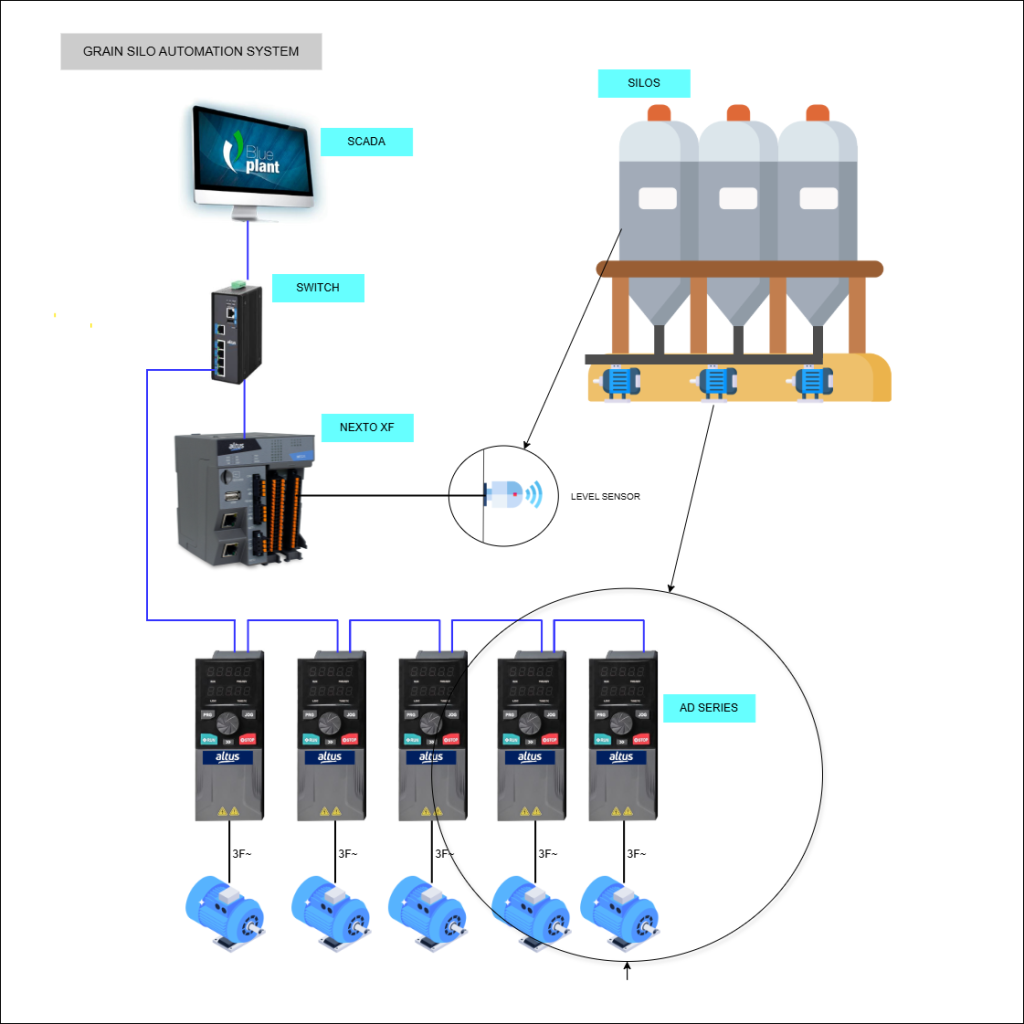
The inverters play a fundamental role in the efficiency and reliability of the application, as they enable soft starts, precise speed control, and reduced energy consumption. Based on signals from level sensors installed in the silos, the PLC automatically adjusts the motor speed according to the process requirements, preventing overflows and reducing mechanical stress on the equipment.
Furthermore, the system facilitates diagnostics and preventive maintenance, as inverter faults and alarms can be viewed in real-time on the SCADA, increasing the operational availability and safety of the plant.
Strategic benefits of adopting inverters
- Energy Efficiency and Sustainability: One of the primary benefits provided by frequency inverters is a significant reduction in electrical energy consumption, especially in variable load applications such as pumps and fans. Beyond reducing operational costs, lower energy consumption directly contributes to decreasing the carbon emissions of industrial operations, assisting companies in meeting decarbonization goals and strategies aligned with ESG (Environmental, Social, and Governance) practices.
- Maintenance Cost Reduction: By facilitating smoother starts and stops, inverters minimize current peaks and reduce mechanical stress on equipment. This precise control increases the service life of components such as bearings, belts, couplings, and motors. The result is higher operational availability and lower total maintenance costs.
- Process Precision and Quality: Vector control features allow for extremely precise control of speed and torque, even in applications with high dynamic variation. This precision provides greater stability, improves final product quality, and reduces waste in industrial processes that require synchronism, repetition, and refined motion control.
The choice between the AD600 and AD700 series depends directly on the scale, complexity, and requirements of your application.
While the AD600 series stands out for its compactness, ease of integration, and excellent cost-benefit for machines, the AD700 series positions itself as a platform prepared for the challenges of Industry 4.0 through its high connectivity, modularity, and integrated safety features.
By investing in Altus frequency inverters, industries rely on the support of a company that combines cutting-edge technology, specialized technical support, and deep knowledge of the demands of the most diverse industrial sectors. With the AD series, Altus continues to drive the evolution of automation, transforming energy into productivity through intelligent, reliable solutions prepared for the future of the industry.