







PROFINET is one of the most widely used communication protocols in industrial control and supervision networks. Present in approximately 20% of automation applications in the global market, it is extensively adopted in critical process control systems that demand high availability and operational reliability.
One of the features that supports this high level of reliability is the PROFINET MRP (Media Redundancy Protocol) standard, specifically developed for implementing ring architectures with fast failure recovery.
Were you already familiar with this feature? Throughout this article, we will explore in detail the relationship between the PROFINET protocol and the MRP standard, explaining how this combination allows for the construction of highly available ring architectures, enhancing the resilience of industrial control and supervision systems.
What is the PROFINET protocol?
Developed by PROFIBUS & PROFINET International (PI), PROFINET is one of the most widely used protocols in the world, especially on the European continent. The standard enables the exchange of a large volume of data by applying the same electrical model adopted by traditional Ethernet networks.
This consolidation opened up a range of automation solutions, thanks to the ability to manage data traffic and the high speed provided by Ethernet.
The protocol has an open profile that covers all industrial automation technology requirements. The model is 100% compatible with IEEE standards and meets system requirements with its flexible topology.
By using the PROFINET protocol, it becomes possible to establish transparent communication between management, supervision, control, and field device levels, while always respecting the specific performance and response time requirements of each industrial automation element.
Just like PROFIBUS, PROFINET is widely adopted in the process industry, present on the factory floor in transducers, transmitters, and various other field devices, which reinforces its versatility and reliability in industrial environments.
With different standards, the PROFINET model offers support for a wide variety of Industrial Ethernet networks. Below, we briefly explore each one regarding their characteristics and applications.
The different types of the PROFINET protocol:
- PROFINET I/O (Input/Output): Used for data communication between input/output devices and PLCs; it is the most applied standard in industrial automation for field device control and supervision.
- PROFINET RT: The RT standard offers real-time communication, making it ideal for industrial applications that require fast communication but without the need for exact synchronization.
- PROFINET IRT (Isochronous Real-Time): This protocol is an extension of PROFINET RT; however, it offers deterministic real-time communication with high temporal precision. Ideal for applications requiring strict synchronization and low latency, such as motion control in machinery, robotics, and high-speed process automation.
- PROFINET CBA (Component Based Automation): This standard takes a component-based approach that allows for the modular and reusable configuration of automation systems, facilitating integration and maintenance. It is used for automating complex systems where modularity and component reusability are important.
- PROFINET I/O Device Redundancy: This standard offers redundancy for input and output devices to ensure operational continuity in case of device failure. Essential in applications where system availability is crucial, it ensures that failures in one device do not interrupt the automation process.
- PROFINET MRP (Media Redundancy Protocol): PROFINET MRP is a protocol that offers media redundancy to ensure high network availability, allowing for fast recovery in case of network failure. We will talk more about this standard in the following paragraphs.
What is PROFINET MRP and how does it work?
An acronym for Media Redundancy Protocol, MRP is a network protocol that can be used in certain devices compatible with PROFINET technology. It allows for the configuration of networks in a ring topology, creating small individual domains within larger networks.
For an application using this topology to be possible, only devices providing at least two Ethernet ports can be included in an MRP ring. For devices with more than two ports, it is necessary to configure which ports will be used as ring ports to establish the series connection.
The configuration of MRP in a ring topology requires all nodes to support MRP, and at least one of them must act as the network Manager, known as the MRM (Media Redundancy Manager). Thus, if transmission is interrupted for any reason, the ring manager can immediately activate alternative communication within a millisecond interval.
The MRM monitors and controls the ring topology by continuously sending test frames to traverse the entire length of the network. These frames are forwarded through the ring ports of all Clients, called MRC (Media Redundancy Client).
An MRC is a device that acts only as a “forwarder” of frames and generally does not take an active role. If an MRC detects a fault, such as a connection drop, it can send a special message to the MRM reporting this fault, reducing the communication reconfiguration time.
The MRP ring is considered as two line topologies where all clients remain connected to the manager. As long as the manager receives the test frame at its other port, it considers the network connections to be intact. In this scenario, the MRM blocks one of its ports, and data packets are transmitted in only one direction of the ring.
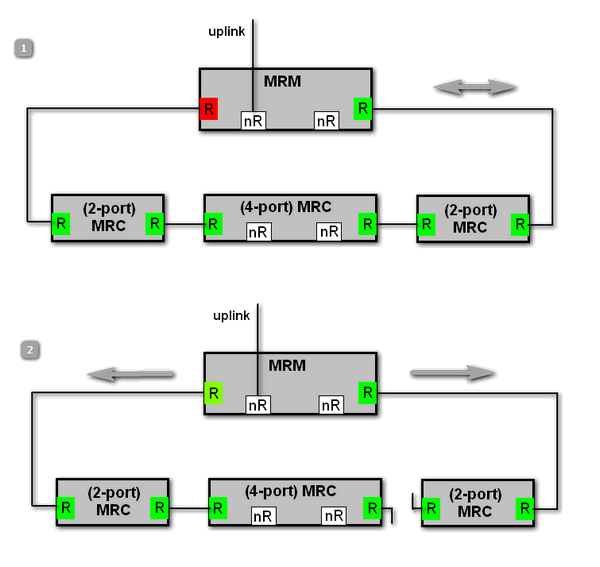
If a section of the ring is interrupted, the MRM stops receiving frames on both ports. Upon identifying this condition, it notifies the MRCs of the network failure and unblocks the previously blocked ring port, re-establishing communication through the alternative topology.
Regardless of whether the interruption is caused by a physical media failure or an intermediate device that retransmits data, the redundancy mechanism operates in the same way. After the problem is corrected and the ring topology is restored, the MRM blocks its second port again, returning to the normal “closed ring” state.
Another strategy to further increase network reliability is the use of multiple MRMs in the same ring, preventing downtime in case of a primary manager failure. In this configuration, all candidate devices must be set to manager-auto mode. Only one of them will effectively assume the manager role, while the others will operate as clients, ready to take control if necessary.
The advantages of using a ring architecture
Ring architecture is a type of network configuration where devices are connected in a circular fashion, forming a closed loop. In this arrangement, each device is linked to exactly two other members of the network, creating a continuous path for data transmission. This means that data travels in only one direction around the ring, passing through each device until it reaches its destination.
In a ring architecture, data is transmitted from one device to the next in a sequential manner. When you send data from your device, it travels to the next member of the ring network, and that equipment passes it to the next, until the data reaches the final recipient. Each device in the ring acts as a repeater, retransmitting the data and ensuring that it continues to flow around the ring.
One advantage of ring topology is that it provides equal access to all devices on the network. Since data travels in a circular path, each device has the same opportunity to send and receive data.
Additionally, ring networks can handle large data loads more efficiently because each device has dedicated time slots to transmit data, reducing the chances of collisions.
PROFINET MRP Ring Network with the NX3008 CPU
Created to meet the demands of an increasingly connected industry, the NX3008 CPU features a wide variety of communication interfaces capable of connecting the equipment to the most diverse systems and machines on the market. As the most advanced control device in the Nexto NX series, it has 3 Ethernet ports, 2 of which support the PROFINET Controller communication protocol, allowing the controller to be used in a network with MRP ring architecture.
Fully aligned with the IoT universe, this CPU offers direct writing capability to MSSQL databases and native integration with major cloud computing services such as Microsoft Azure, IBM Cloud, Google Cloud, and Amazon AWS.
The NX3008 further stands out due to a feature found in few PLCs on the market: the embedded WebServer. This functionality allows for the creation of supervision and monitoring screens directly within the controller, eliminating the need for a dedicated SCADA system for smaller-scale applications.
Another standout feature is the Embedded VPN, which creates a private connection tunnel directly to the CPU. This functionality allows you to access your business’s control network remotely and completely securely. To further increase product security, the CPU includes a firewall feature.
The CPU also supports FTP connections, which enables the device to exchange data with a server using this technology model. This functionality allows data packets generated by the controller, such as logs collected through a datalogger function, to be accessed remotely.
Another highlight is the native Docker platform. Native to the CPU, this capability allows for application virtualization, significantly expanding the system’s versatility and operational agility. By enabling the processing of multiple services and data directly on the CPU itself, this feature reduces reliance on external hardware and accelerates the execution of more advanced functions in the industrial environment.