






In previous articles, we explored the fundamental concepts of Docker, the reasons why this containerization technology has been gaining ground, and the benefits it brings to modern Edge Computing architectures.
Now, it is time to move beyond theory and demonstrate how Docker functions in practice inside shop-floor PLCs. The evolution of industrial automation requires control systems to go beyond deterministic scans; they must process and share data efficiently with cloud systems. Embedded Docker enables this convergence by isolating microservices from the main automation logic without compromising process control integrity.
Below are four applications currently running in the field:
1st application: MQTT Mosquitto + Node-RED
In a traditional architecture, building a telemetry layer requires external communication gateways or additional industrial PCs, an infrastructure that consumes panel space, uses power, and introduces single points of failure to the network. With embedded Docker on the PLC, this entire infrastructure is deployed directly at the edge.
In this architecture, Mosquitto functions as a lightweight message broker, operating on a publish/subscribe model with extremely low latency and minimal memory footprint. Concurrently, Node-RED runs in an independent Docker container, providing a low-code, node-based development environment to filter, transform, and route process data without complex custom code or interference with the PLC’s core control logic.
To make operational metrics accessible, the PLC program publishes process variables, such as temperatures, pressures, machine states, and production counters, to the local Mosquitto broker via an MQTT client or internal bridge. Node-RED subscribes to these message topics and processes them right on the controller.
This enables a variety of asset monitoring and predictive maintenance functions without overloading network bandwidth:
Local dashboards: Rapid creation of lightweight HTML5/WebSocket web interfaces accessible via tablets or browsers on the plant network.
Automated alerts and notifications: Immediate dispatch of fault alerts to team groups via Telegram or automated email services.
External service integration: On-node data filtering for streaming structured metrics to corporate platforms or cloud databases via HTTP/REST APIs.
How this application works in practice:
– An analog input on the PLC detects a temperature value exceeding a critical threshold from a connected sensor.
– The PLC application publishes a JSON message to the local topic fabrica/linha1/prensa/temperatura hosted on the Mosquitto broker.
– A Node-RED node subscribes to the topic, captures the event, and triggers a validation function written in JavaScript.
– Node-RED formats an HTTP POST request and dispatches an instant notification to the Telegram API: “Alert: Press 01 Temperature exceeded 85ºC”.
Containerizing these tools ensures that installing, updating, or maintaining Node-RED or Mosquitto occurs without interrupting the execution of the main control program. Should a Node-RED flow encounter an exception or a missing library, the isolated container can be restarted independently without risking physical operational downtime for the controlled machine
2nd application: WebIQ + LinkIQ
WebIQ is an HMI platform built on native web technologies (HTML5, CSS3, and JavaScript), designed to render responsive process visualizations inside a Docker container. LinkIQ serves as a complementary intelligent software gateway, connecting machinery from different vendors and translating the various protocols involved in the production process.
In a practical scenario, LinkIQ runs in a container to collect data from legacy PLCs and field instrumentation distributed across the industrial plant. This data is standardized and made available locally to the WebIQ container, which serves supervisory screens to multiple web clients.
This edge connectivity and integration enables:
Decentralized process visualization: View plant schematics, trend curves, and alarm logs on any web browser-enabled device, eliminating the need for dedicated physical HMIs mounted on panel doors.
Multi-protocol integration: The containerized gateway bridges communication between devices from different manufacturers without requiring dedicated hardware converters.
External connectivity: Streams unified operational data directly to SCADA systems or MES/ERP enterprise software.
In this context, containerization allows software developers to deliver out-of-the-box solutions directly on the control hardware. The open platform concept empowers system integrators to select best-of-breed tools without being locked into a single proprietary hardware or software ecosystem.
See more LinkIQ application cases on our partner Beijer’s website by clicking here
3rd application: Custom HTML Web Server
While HMIs and SCADA systems cover the vast majority of industrial applications, machine builders (OEMs) and system integrators frequently encounter projects requiring bespoke user interfaces or direct integration with enterprise APIs.
This is precisely where running a custom web server inside an HTML5 container showcases the full flexibility of embedded Docker.
In practice, this solution allows engineering teams to build custom web applications using modern front-end frameworks like React, Vue.js, or Bootstrap, hosting them directly inside a web server container on the PLC. Communication between the web client and the controller takes place via REST API endpoints or WebSockets, updating process variables in real time and enabling:
Complete design freedom: Full control over visual layout, tailoring the user experience to match company branding or specific machine requirements.
Lightweight, responsive dashboards: Pages optimized for rapid loading on mobile browsers without consuming excessive controller memory.
Seamless IT and API integration: Effortlessly consume external system APIs, query corporate databases, or interface with barcode scanners and vision systems directly through the browser interface.
For system integrators, this architecture provides a distinct market advantage by delivering functional, tailored software interfaces hosted entirely on the primary control CPU.
4th application: MariaDB Database
To test containerization in the automation environment, our engineering team conducted a Proof of Concept (PoC) running the MariaDB database inside a Docker container directly on the PLC. It is worth noting that this test was performed strictly to demonstrate the technology’s potential.
In this experiment, the MariaDB container locally stored production history, alarm event logs, and batch traceability data directly at the edge. The PLC logic executed SQL write commands to the relational database, proving the feasibility of maintaining structured data repositories at the edge without relying on dedicated enterprise-level IT servers.
This proof of concept highlighted the versatility of the container environment: an industrial CPU is fully capable of running enterprise-standard database engines, expanding the boundaries of traditional automation when designed with proper infrastructure considerations.
The PLC as an Edge Computing platform
Although the four featured applications address distinct operational needs, from lightweight telemetry with MQTT/Node-RED to complex SQL storage, they all share key traits essential for modern automation architectures:
Flexibility and modularity: Easily enable, update, or swap specific functions without redesigning the PLC’s core automation project.
Scalability: Pre-tested containers can be standardized and effortlessly deployed across multiple machines and plant locations.
Streamlined integration: Drastically reduces communication barriers between the shop floor (OT) and information systems (IT).
Application isolation: A fault within an IT microservice does not compromise real-time control safety or scan execution times.
With Docker, the controller evolves from a traditional sequential routine executor into a multi-functional edge computing platform.
Docker on the New Nexto XF Series
The practical adoption of containerized architectures only becomes viable when developed on control solutions engineered specifically for this purpose.
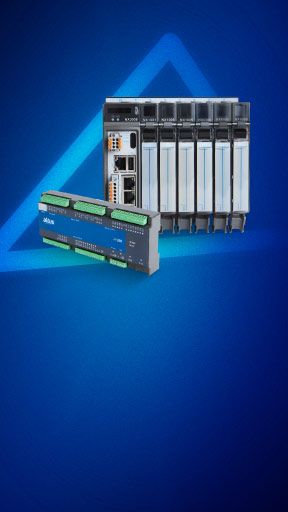
The Nexto XF series of controllers exemplifies this evolution toward Edge Computing by incorporating native support for Docker technology, allowing complementary applications to run directly within the automation environment.
Nexto XF controllers feature 2.5 GB of user and Docker container storage, along with the embedded Portainer management interface, which simplifies creating, managing, and maintaining containers at the edge. See further details below:
| Hardware | Detail | Utility for Docker |
| Processor | ARM Dual-Core 64-bit (1 GHz) | Parallel processing for IEC control logic and containerized microservices |
| Memory | 512 MB RAM / 8 GB eMMC | Support for multiple containers with a recommended Docker RAM limit of 230 MB |
| User memory / Docker | 2,5 GB | Local storage for images, files, and data |
| Interface | 2x Ethernet 10/100 Mbps | Physical and logical separation of control networks and IT/cloud networks |
| Expandable storage | MicroSD Card (up to 32 GB) and USB 2.0 Host Port | External Docker volume mapping to preserve internal eMMC flash memory |
| Cybersecurity | Integrated Firewall and OpenVPN | Data traffic protection and secure remote access to container services |
Programmed with the Mastertool X environment, built on CODESYS technology, the Nexto XF series pairs control determinism with the flexibility of containerization.
Support for multiple protocols including OPC UA, MQTT, Modbus TCP/RTU, PROFINET, EtherNet/IP, EtherCAT, and CANopen reinforces the ability of these controllers to connect Docker applications directly to process data in a secure, fast, and standardized manner.
As highlighted throughout this article, the true value of Docker in industrial automation extends far beyond software isolation or deployment convenience. The primary benefit lies in building a direct bridge between OT engineering, IT departments, and the digitalization initiatives advancing across various industries.
The application cases presented here represent practical steps toward exploring an expanding ecosystem. By transforming controllers into intelligent nodes at the edge of your operation, Docker unlocks new possibilities for an increasingly flexible, integrated, and efficient industrial environment.