






Choosing a PLC requires an evaluation that goes beyond processor performance, the number of I/O channels, or available communication protocols. In today’s automation systems, operational safety, asset integrity, and continuous production rely directly on the hardware’s ability to withstand electrical and environmental stress.
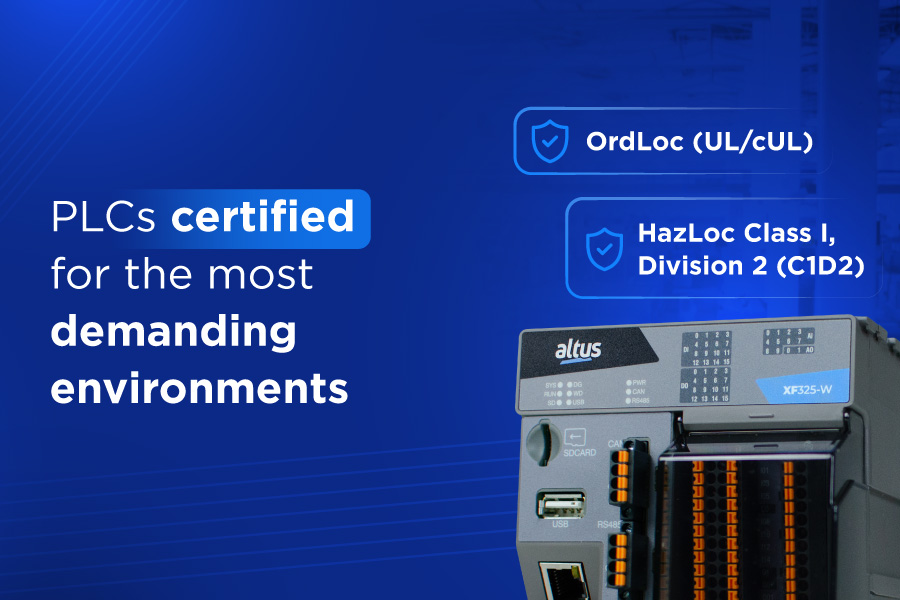
To achieve this, PLC certifications serve as documentary proof that the equipment meets rigorous engineering and safety standards set by independent international bodies, such as UL Solutions. These seals eliminate uncertainties, streamline approval with global clients, and enable the export of machinery and electrical panels to highly regulated markets, such as the United States and Canada.
Our latest controller series, the Nexto XF Series, already features a complete portfolio of certifications. Learn more about the importance of a detail that is often overlooked when evaluating a PLC.
OrdLoc certification (UL/cUL): electrical safety and standardization
OrdLoc certification, short for Ordinary Locations, is the electrical safety baseline for equipment installed in conventional industrial environments.
These locations are defined as operational areas free from continuous, periodic, or accidental explosion risks caused by flammable gases, vapors, or combustible dusts. For industrial controllers, the OrdLoc certification process is conducted based on harmonized standards, such as UL 61010-1 in the United States and CSA C22.2 No. 61010-1 in Canada. This certification attests that the device has undergone testing batteries and been approved under the regulatory requirements of both countries.
The primary focus of OrdLoc certification is to mitigate risks that electrical equipment may pose to personnel and facilities under normal operating conditions and foreseeable fault scenarios. Evaluated requirements include insulation dielectric strength, component temperature rise limits under full load, flame enclosure containment, protection against electrical shock, and mechanical impact resistance.
In manufacturing production lines, food and beverage plants, or building utilities systems, the presence of the OrdLoc mark guarantees that the PLC will operate reliably without risk of fire or electric shock, streamlining commissioning processes and safety audit approvals.
HazLoc Class I, Division 2 (C1D2) Certification: protection for potentially explosive atmospheres
Unlike ordinary environments, various industrial sectors operate with raw materials and processes that release flammable substances into the air. HazLoc certification, short for Hazardous Locations, validates equipment capable of operating in atmospheres with explosive potential.
In North America, hazardous area classification follows the guidelines of the National Electrical Code (NEC Article 500) and is regulated for electronic control equipment under the UL 121201 standard and its Canadian equivalent, CSA C22.2 No. 213.
The designation Class I, Division 2, Groups A, B, C, and D (C1D2) defines the specific technical boundaries for the controller:
Class I: Specifies that environmental risk arises from the presence of flammable gases, flammable liquid-produced vapors, or combustible liquid-produced vapors mixed with air in proportions capable of propagating fire.
Division 2: Indicates that flammable substances are safely confined within closed containers, piping, or systems under normal operating conditions. Unlike Division 1,where flammable gas is present in the atmosphere during standard operation, Division 2 explosion risks arise only during abnormal or accidental situations, such as leaks, pipe ruptures, valve seal failures, or unscheduled ventilation system shutdowns.
The group breakdown categorizes the specific gases and vapors for which the equipment has been tested, based on their minimum ignition energy and explosion pressures:
Group A: Refers to acetylene, a substance with the lowest ignition energy and highest explosion severity among industrial gases.
Group B: Includes hydrogen and other extremely volatile gases with rapid burn rates.
Group C: Encompasses substances such as ethylene, carbon monoxide, and ethyl ether.
Group D: Covers hydrocarbons and solvents widely used across industries, including propane, methane, gasoline, naphtha, and alcohol.
C1D2 certification under UL 121201 relies on the principle of non-incendive equipment. This means the PLC’s internal electronic circuits and components are designed and arranged so that, during normal operation, any electrical arcing or sparking lacks sufficient energy to ignite the surrounding atmosphere. Furthermore, surface temperatures remain strictly below the autoignition point of adjacent gases.
This eliminates the need to enclose the controller in heavy explosion-proof housings, allowing the panel to be assembled using standard enclosures (provided all installation conditions specified in the certificate are met), even when deployed in Division 2 hazardous locations.
Nexto XF Series: native integration of reliability and performance
The Nexto XF Series is our fifth generation of controllers, combining high I/O density, intelligent edge computing processing power, and extensive connectivity: two 10/100 Mbps Ethernet ports, an RS-485 serial interface, a CAN port, a USB interface, and support for open protocols such as OPC UA, MQTT, PROFINET, EtherNet/IP, and MODBUS.
To protect integrated circuits against aggressive agents, the controller printed circuit boards undergo an industrial conformal coating process, applying a non-conductive protective layer against humidity, salt spray, dust, and corrosive atmospheres.
By combining OrdLoc (UL/cUL) and HazLoc C1D2 (UL 121201) certifications in a single hardware platform, Nexto XF Series controllers deliver a robust solution for diverse environments. These certifications bring direct, practical benefits across the entire automation value chain:
| Comparison parameter | OrdLoc (UL/cUL) | HazLoc C1D2 (UL) |
| Base standards | UL 61010-1 and CSA C22.2 No. 61010-1 | UL 121201 and CSA C22.2 No. 213 |
| Type of industrial environment | Ordinary locations without explosion risk | Classified hazardous locations with accidental risk of gases and vapors |
| Focus of protection | Overheating, electric shock, and internal fire | Prevention of electrical arcing, sparks, and ignition temperatures |
| Chemical agents covered | Not applicable | Groups A (Acetylene), B (H₂), C (Ethylene), D (Methane/Propane) |
| Impact on panel design | Compliance with standard electrical safety standards | Elimination of explosion-proof enclosures in Division 2 |
For original equipment manufacturers (OEMs), international certification simplifies export operations. Machinery equipped with the Nexto XF Series meets North American market requirements without needing electrical redesigns or supplier changes. The same machine model can be commercialized across pharmaceutical, textile, or chemical industries.
Certifications also streamline the specification process, enabling standardization of the Nexto XF Series across an entire industrial plant architecture. The same controller can be installed in the main control room (non-classified area) or in a decentralized field panel near pumps and compressors (C1D2 hazardous location). This reduces programming development hours and simplifies training for assembly and maintenance teams.
For operations teams, compliance with UL/cUL standards ensures operational continuity with a high level of safety. In plants subject to process variations or risks of accidental solvent or gas leaks, the controller’s non-incendive technology helps prevent severe accidents.
Furthermore, hardware standardization minimizes spare parts inventory and lowers the Total Cost of Ownership (TCO) over the facility’s lifecycle.
How certifications expand application possibilities
The international PLC certifications of the Nexto XF Series meet the requirements of several critical sectors, where the presence of the right controller ensures regulatory compliance and high availability:
Oil & Gas and Petrochemicals: The PLC controls extraction wells, metering skids, filtration systems, and natural gas compression units. C1D2 certification for Groups B and D ensures the equipment operates with total safety in the accidental presence of hydrogen, methane, and hydrocarbon vapors.
Water and Wastewater Treatment: Raw sewage lift stations and anaerobic reactors exhibit sporadic build-ups of hydrogen sulfide and biogas/methane (Group D). Using the Nexto XF Series combines C1D2 certification with conformal coating treatment, guaranteeing protection against gas ignition while providing corrosion resistance for electronic circuit boards against humidity and effluent gases.
Chemicals and Paints: In facilities storing and handling organic solvents and alcohols, the environment surrounding tanks and dosing units is classified as Class I, Division 2. The Nexto XF Series offers precise control over mixing processes backed by non-incendive design guidelines.
Renewable Energy and Biogas: Energy generation from organic waste exposes control equipment to methane-rich atmospheres. Nexto XF Series controllers enable field sensor connectivity and transfer data via MQTT and OPC UA to cloud systems with full hazardous location compliance.
Food, Beverage, Packaging, and Manufacturing: In sectors without explosive atmosphere risks, OrdLoc certification (UL/cUL) ensures equipment operates at maximum capacity under rigorous electrical safety requirements, keeping machines running continuously and compliant with quality audits.
As demonstrated, selecting a controller for automation projects demands an integrated perspective encompassing performance, connectivity, and regulatory compliance. OrdLoc (UL/cUL) and HazLoc C1D2 (UL 121201) certifications validate hardware excellence and suitability for the global market’s most demanding scenarios. Choosing equipment tested and approved by international organizations minimizes accidental risks and optimizes infrastructure investments.
The Nexto XF Series is a versatile platform for the smart automation era, uniting advanced control, extensive connectivity, and certified safety to turn industrial challenges into operational efficiency.