






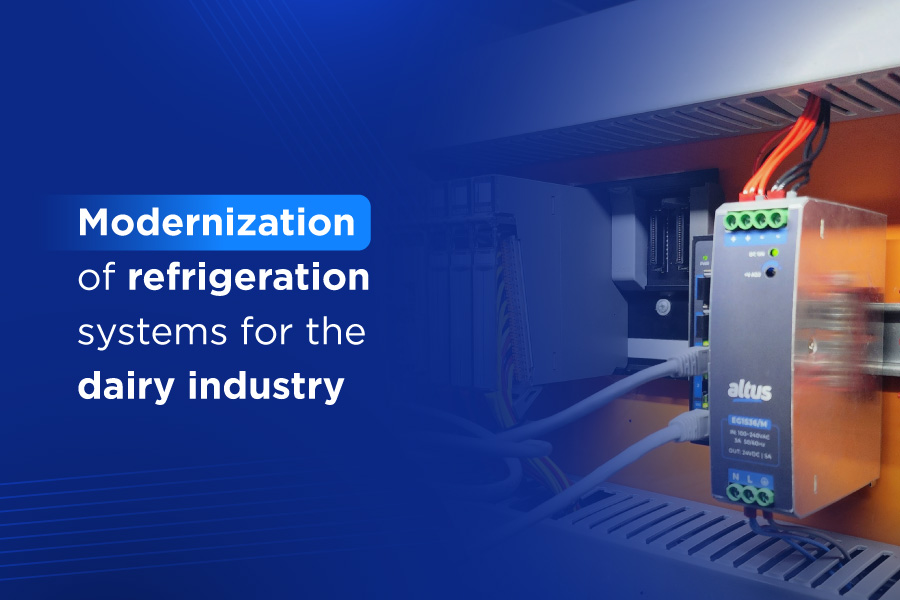
The integrity of refrigeration systems in the dairy segment is the primary factor in preserving product quality and ensuring compliance with sanitary requirements. Within this process lies ammonia refrigeration, a system offering high thermal efficiency, yet requiring rigorous variable control due to the fluid’s toxicity and the high pressures involved. Properly managing ammonia compressors demands automation architectures capable of guaranteeing high availability, precise monitoring, and total mitigation of operational risks.
In this context, Eletro Líder Elétrica e Automação Industrial, headed by Director and Automation Engineer Erick Fellipe de Freitas, designed and implemented a technological modernization plan for Imbaúba Laticínios.
By replacing an obsolete analog infrastructure with a control platform based on Altus technologies, the modernization transformed a vulnerable operation into a model of efficiency. Learn more details about this project in the paragraphs below.
The challenge: transition from analog legacy to digital security
The Imbaúba Laticínios plant operated with a fully analog refrigeration control system. This limited process management, as the lack of data records prevented performance reporting and predictive failure analysis. Operations relied on manual checks and isolated devices, which increased the likelihood of unplanned downtime and raised maintenance costs.
The catalyst for restructuring the system was the need to raise safety and reliability standards in the operation of the ammonia compressor. In parallel, the company sought to optimize electrical energy consumption, one of the largest operational costs in the sector, and improve the thermal efficiency of the refrigeration plant.
Controlling ammonia compressors requires fast responses to any pressure or temperature variations: undetected deviations in motor lubrication or in fluid suction and discharge can damage the main equipment or trigger ammonia leaks. The challenge was therefore to design an automation architecture from scratch, integrating redundant instrumentation, peripheral control, and a simplified operator interface, all without interrupting production.
The developed solution: programmable architecture and integrated control
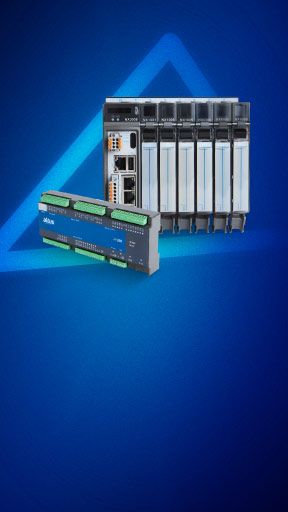
To meet safety and efficiency requirements, a solution based on Altus controller lines and peripherals was developed. The project spanned from hardware specification to field commissioning, structuring a control loop capable of automatically managing compressor startup, monitoring critical parameters, and coordinating auxiliary equipment.
Field instrumentation was distributed across the compressor’s three sectors: oil, suction, and discharge. In each of these sections, analog pressure transducers and PT100 temperature sensors were installed, ensuring continuous readings and measurement redundancy. To guarantee compliance with safety standards, the application was also equipped with redundant contacts via mechanical pressure switches and protection relays interfaced with the controller. More details below:
| Component | Altus‘ product | Process function |
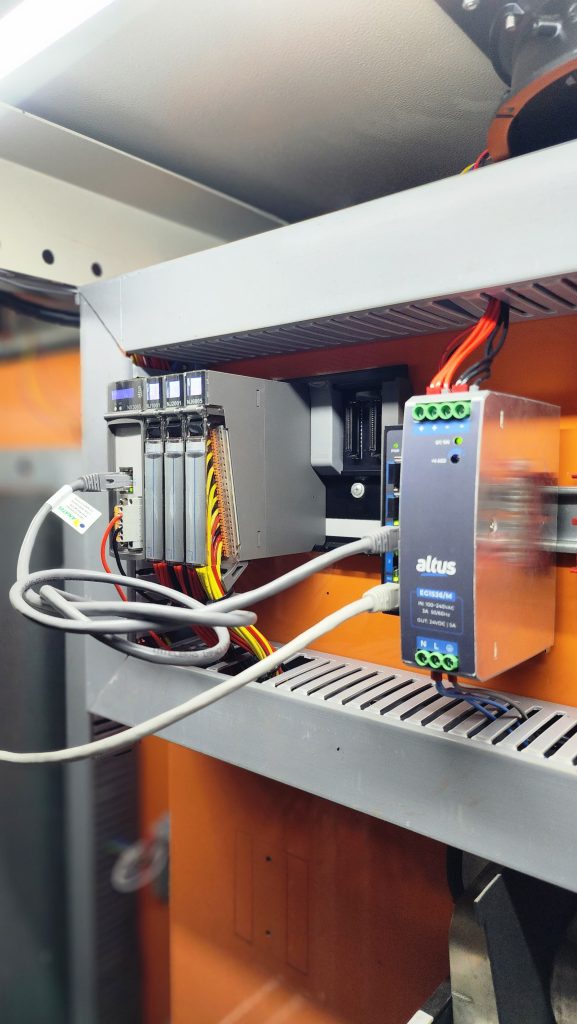
| PLC | NX3005 | Central unit responsible for processing logic, safety, and interlocking. |
| I/O modules | NJ1001, NJ2001 and NJ6005 | Acquisition of analog pressure/temperature signals and discrete actuation control. |
| Power supply | 24 Vdc / 5 A | Stabilized power supply for control modules and field instruments. |
| Network infrastructure | Industrial switch | Data communication over Ethernet network between controllers and peripherals. |
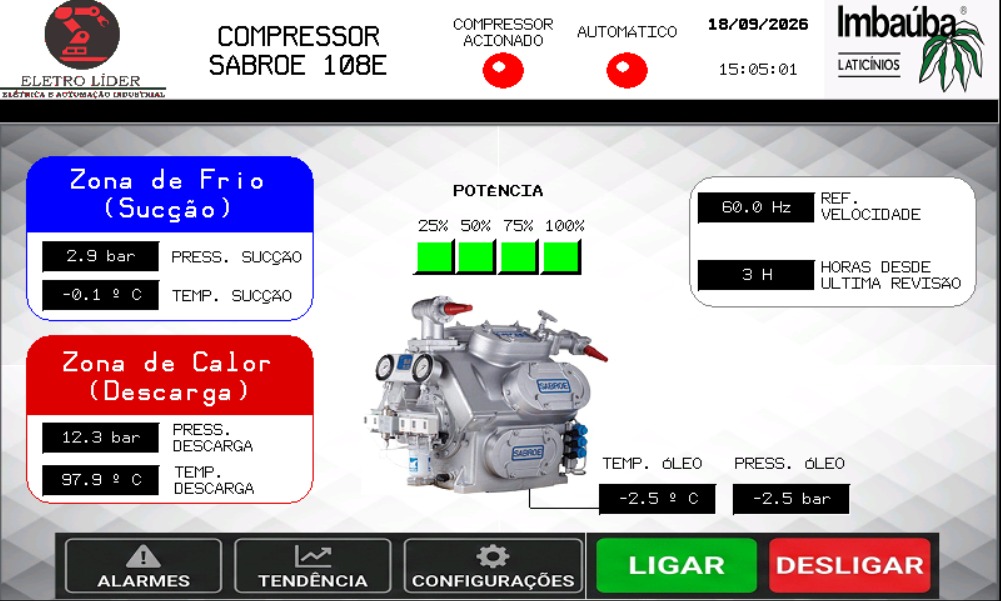
| Operator interface | HMI via Modbus RTU | Local visualization of parameters, manual/automatic operation, and alarm management. |
| Field sensors | 3 pressure transducers and 3 PT100 modules | Continuous monitoring of compressor oil, suction, and discharge. |
The logic developed in the controller only authorizes compressor startup after confirming that all process variables and safety interlocks are within nominal ranges. During operation, the system monitors oil pressure, working pressure, and safety limit pressures. The automation also manages cooling water flow to the compressor and commands the activation of associated peripherals, such as the ammonia pump and the cooling tower.
Key advantages of the applied technology
Equipment selection for the architecture took into account hardware robustness, programming environment flexibility, and cost-effectiveness for the client.
The use of Nexto NJ modules with push-in connectors eliminated the need for tools to secure electrical conductors, reducing panel assembly time and preventing accidental disconnection caused by continuous mechanical vibration—a common condition in compressor rooms.
For fast field diagnostics, the front display of the NX3005 CPU enabled instant visualization of output status, process variables, and error codes without requiring service computers to be connected.
In software development, the Mastertool platform, based on the CODESYS environment, facilitated system programming and parameterization. The absence of licensing fees for the development environment further reduced the total implementation cost of the project.
To complete the application, the integrated WebVisu functionality on the controller enabled the creation of supervisory interfaces accessible via web browser, allowing remote monitoring of the refrigeration operation without requiring additional SCADA system licenses.
Results achieved: energy efficiency and operational stability
The implementation of the automation system brought about the complete digitalization of Imbaúba Laticínios’ refrigeration plant. Transitioning from analog control to a programmable control loop delivered direct gains in energy efficiency, operational safety, and production process reliability.
The ability to modulate compressor speed according to the factory’s actual thermal demand eliminated energy waste during periods of low milk processing loads. Meanwhile, enhanced control over suction and discharge pressures resulted in stabilized temperatures across cold rooms and heat exchangers, optimizing the refrigeration system’s efficiency.
Facility safety was also elevated thanks to the redundant sensor architecture and immediate automatic shutdown in the event of anomalies. Such efficiency established the project as a technical reference model in the region, drawing interest from industry professionals keen to replicate the architecture in other industrial plants. Observe the change in scenario below:
| Operation | Analog scenario | Automated scenario | Result achieved |
| Load control | Continuous operation at fixed speed | Dynamic modulation of compressor speed | Reduction in electrical energy consumption during periods of low thermal load. |
| Safety | Individual point monitoring | Triple sensors and interlocked relays | Immediate automatic shutdown upon any process deviation. |
| Peripheral management | Decentralized manual operation | Interlocked automatic sequencing | Mitigation of failures due to pump cavitation or overheating. |
| Information management | Complete absence of reports and data | Real-time digital telemetry and WebVisu | Traceability of temperature, pressure, and alarm variables. |
“This project was our first experience with Altus, and people from outside the state have already praised the system and want to sell it to other clients. I would like to extend a compliment to Maicon (sales team), who always stays in touch with us, as well as to the support team, who follow up the next day to ask if everything is okay even when we solve a problem together,” said Erick Fellipe de Freitas, Director and Automation Engineer at Eletro Líder Elétrica e Automação Industrial.
The development of this project reinforced the importance of cooperation. Eletro Líder’s performance, combined with Altus’s post-sales technical support and the availability of the commercial team, ensured accuracy during commissioning and rapid resolution of technical queries throughout the project.
The future of automated system integration will rely increasingly on intelligent, connected, and secure architectures, from the edge to the cloud, enabling new levels of operational excellence in an increasingly competitive landscape.