






In a market where margins are squeezed by input costs and regulatory requirements, production process stability often defines the line between profit and loss.
An unexpected shutdown due to a logic control failure results in an immediate financial impact. Data released by ABB (a Swiss multinational specializing in automation technologies) indicates that the Brazilian industry loses, on average, more than R$ 700,000 per hour during unplanned downtime events. This figure encompasses idle labor, energy consumed without production, asset deterioration, and penalties for delays, highlighting the risk of operating without safety systems and high availability.
The global scenario is equally concerning. Studies conducted by Aberdeen Research and Vanson Bourne point out that 82% of industrial companies recorded at least one unforeseen downtime event in the last three years. With an average duration of four hours per incident, the total cost reached $2 million per event, directly affecting ROI and the productivity of critical assets.
Given this scenario, the logic is clear: implementing an architecture with a redundant controller represents a predictable, controlled, and plannable cost. Unplanned downtime, on the other hand, generates chaotic, unpredictable expenses with a catastrophic growth potential. In this article, see how applying redundancy to your operation can change this outlook.
The true cost of unplanned downtime
A detailed analysis of operational losses makes it clear that the cost of downtime varies drastically depending on production volume, technological complexity, and the level of supply chain integration. In sectors with continuous flows or highly integrated chains, the failure of a controller without redundancy can generate immediate losses of severe proportions.
Below is a comparison of direct costs and factors associated with downtime across different market segments, based on domestic and international benchmarks:
| Segment | Average cost of downtime | Key impacts |
| Automotive | US$ 2.3 million per hour | Immediate disruption of automated assembly lines, frequent component failure, and high maintenance expenses. |
| Offshore | US$ 38 million per year | Shutdown of high-pressure wells, complex logistics for emergency supplies, and massive losses in extraction volume. |
| Chemical | US$ 154.7k per hour | Polymer solidification in pipelines, risks of uncontrolled thermal reactions, and the need for complete manual system purging. |
| Food and Beverage | US$ 36,000 per hour | Loss of microbiological integrity, thermal degradation of perishable raw materials, and long sanitization cycles. |
| Pharmaceutical | Total batch disposal (frequently exceeding $3 million) | Loss of process traceability data required by good practice regulations and disruption of critical validation cycles. |
| Energy | Direct reduction in all operational revenue | Regulatory penalties applied proportionally to the minutes of interruption in Transmission Lines and substations. |
The data proves it: a few hours of downtime generate financial losses far exceeding the cost of acquiring and installing a redundant CPU architecture. Preventative investment in automation with redundancy is the definitive neutralization of a risk that can consume the net margin of entire months of operation.
The invisible losses that rarely make the ledger
A common mistake when estimating the financial impact of a shutdown is accounting only for the most evident factors: lost production and idle labor hours. In practice, a large-scale plant involves a network of secondary costs that rarely enter the analysis, but make the real cost of the event far greater than calculated:
Loss of Raw Material in Process: In continuous process industries, controller failure interrupts ongoing chemical reactions and compromises fluids that depend on controlled temperatures. The result is the disposal of products and entire batches that were mid-line, representing one of the largest revenue drains in this type of operation. Added to the scrap of expensive materials are the costs of logistics and environmental treatment for hazardous waste.
Damage to Equipment and Critical Assets: Abrupt shutdowns prevent turbines, compressors, high-pressure hydraulic pumps, and furnaces from following planned thermal and mechanical deceleration routines. The sudden interruption generates severe mechanical stress, component fatigue, water hammer, and internal thermal overload, leading to breakdowns, accelerated wear, and corrective replacements of high-value components, with a direct impact on the asset life cycle.
Emergency Maintenance Costs: Mobilizing technical teams outside a planned schedule comes at a price. It is estimated that emergency interventions cost two to three times more than the same maintenance performed predictively and on schedule.
Commercial and Reputational Impacts: On the business side, recurring shutdowns result in contractual penalties for missed deadlines and, what is even more costly in the long run, a loss of credibility in the market. Clients facing frequent supply disruptions do not wait; they initiate bidding processes with competitors and often terminate long-term contracts.
Operational Re-establishment and Administrative Burden: The financial impact does not end when the plant resumes operation. Revalidating processes under regulatory standards, compiling technical reports, and conducting post-incident audits consume weeks of labor, diverting teams from innovation and efficiency improvement projects that generate real value for the business.
The ROI math of redundancy
The following scenario simulates the reality of a medium-to-large industrial plant in Brazil, operating on continuous shifts with an estimated unplanned downtime cost of $ 500,000 per hour (a conservative figure slightly below the national industrial average in Brazil).Redundancy as a Survival Policy in the Industrial Market
In the conventional model, without redundancy, a hardware failure in the controller halts the entire production line. Industrial reliability statistics indicate that systems in this configuration suffer, on average, two catastrophic control failures per year, with a mean time to repair and restart of 4 hours per event, totaling 8 hours of annual downtime.
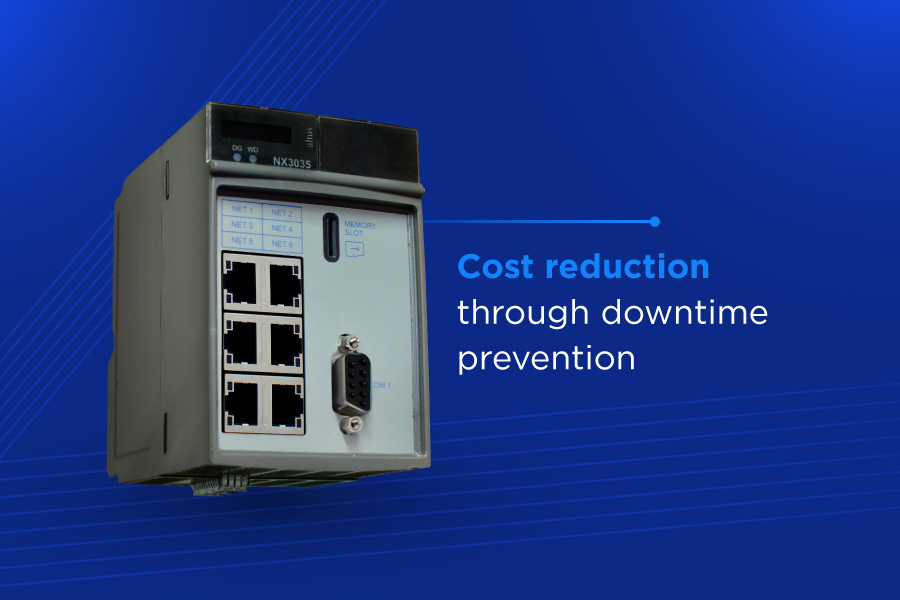
With the Altus NX3035 redundant controller, this downtime caused by processor failure drops to zero. The automatic and instantaneous bumpless transfer between CPUs guarantees operational continuity without human intervention.
Below is a comparison of the accumulated costs over 5 years of operation for both scenarios:
| Financial parameter | Scenario with non-redundant CPU | Scenario with a redundant CPU |
| Initial hardware investment | Average of R$ 60,000 (CPU and peripherals) | Average of $ 250.000 (complete solution) |
| Commissioning cost | $ 20.000 | $ 50.000 |
| Annual maintenance cost | $ 10.000 | $ 15.000 |
| Mean time to repair (annual) | 8 hours | 0 hours with native hot standby bumpless transfer |
| Direct loss per hour of downtime | Average of $ 500.000 | $ 0 |
| Accumulated annual downtime cost | Average of $ 4.000.000 | $ 0 |
| Downtime losses over 5 years | Average of $ 20.000.000 | $ 0 |
| Total cost over 5 years | $ 20.130.000 | $ 375.000 |
The return of approximately 8,990% leaves little room for doubt: investing in a high-availability architecture is not just an engineering expense; it is a cash preservation and protection strategy with a profitability that is hard to ignore.
The payback period is equally compelling: dividing the initial investment differential by the downtime cost of R$ 500,000 per hour shows that the redundant system pays for itself in just 26 minutes of continuous operation that, without it, would be lost during the very first failure.
What happens when a controller without redundancy fails
The following comparison illustrates, in practice, the difference between operating with and without redundancy, and why this choice defines the risk profile of the entire operation.
What happens when a conventional system fails:
Minute 00:00 — Controller Failure: An electrical surge or overheating brings down the CPU. In fractions of a second, all field outputs lose signal: valves close, motors stop, and compressors lock up. The entire plant goes into a fail-safe state.
Minute 00:05 — Generalized Alarm: The SCADA system loses communication with the main controller. Red screens take over the monitors, and audible timeout notifications are triggered. Operators attempt to intervene via the manual console, with zero response from the field.
Minute 00:15 — Technical Team Mobilization: The maintenance team is dispatched and rushes to the control room. With only 15 minutes of downtime, the accumulated cost already exceeds R$ 110,000.
Minute 00:45 — Diagnosis Confirmed: After testing the communication ports and power supply, the verdict is in: the central processor is blown and must be replaced. The search for a spare module in the warehouse begins.
Minute 01:30 — Hardware Incompatibility: The spare module is found, but it is an older hardware revision with outdated firmware that is incompatible with the local network. A manual firmware update must be performed before making any progress.
Minute 02:30 — Program Recovery: Under high pressure, engineering locates the latest version of the source code and begins manually downloading it to the new CPU.
Minute 03:30 — Field Tests: Communication tests with remote I/O modules are conducted to ensure the replacement did not compromise network channels. Alignment of the PLC’s internal logical variables begins.
Minute 04:00 — Recommissioning with New Losses: The process is released for restart, but four hours of inactivity have compromised the material mid-line, which has lost the required properties for use. Cleaning, disposal, and reprocessing consume additional hours before the plant regains full capacity. The total loss for an event of this category can exceed R$ 2 million.
What changes when the architecture is redundant:
Minute 00:00 — Invisible Failure to the Operation: The primary processor on CPU A suffers the exact same failure as in the previous scenario. The difference lies in what happens next.
Millisecond 00:01 — Ultra-Fast Detection: CPU B, installed in a separate rack and kept in continuous synchronization with CPU A via fiber-optic links on SFP ports, immediately detects the absence of the heartbeat signal.
Millisecond 00:05 — Automatic Switchover: CPU B assumes control of the process and transitions to the active state. The bumpless transfer occurs so quickly that the physical outputs controlling switches and actuators in the field suffer no disruption or signal discontinuity. The plant keeps running.
Minute 00:01 — Notification Without Alarms: The control room receives a single alert on the SCADA screen indicating that CPU A is inactive and control was automatically assumed by CPU B. There is no production stoppage, no loss of OEE, and no operational deviations in temperature or pressure.
Minute 00:30 — Diagnosis Without Tools: A technician heads to the control panel room. Upon reaching the panel, they activate the One Touch Diag (OTD) feature directly on the module. The front graphic display of the failed CPU clearly exhibits the diagnostics and message history—no cables or auxiliary computers required.
Minute 00:45 — Hot-Swapping Without Stopping the Plant: With the panel fully energized and production underway, the technician physically removes the damaged CPU and clicks the replacement unit into the rack. The new CPU automatically loads the firmware, retrieves the updated technical documentation stored locally via On Board Full Documentation (OFD) technology, and initiates variable synchronization with CPU B, fully restoring system redundancy without impacting a single second of production.
How the NX3035 protects critical operations
Each integrated feature in the NX3035 CPU was specifically designed to mitigate risks, eliminate operational costs, and protect the plant’s continuous production:
64-bit ARM Processor with Integrated Floating-Point Unit (FPU): The CPU executes complex logic in fractions of a microsecond, just 1.05 µs for every 1,000 ladder contacts and 2.3 µs for advanced mathematical operations. This processing speed allows the controller to run active safety algorithms and high-frequency analog interlocking loops simultaneously, detecting pressure and flow anomalies before they turn into failures or trips.
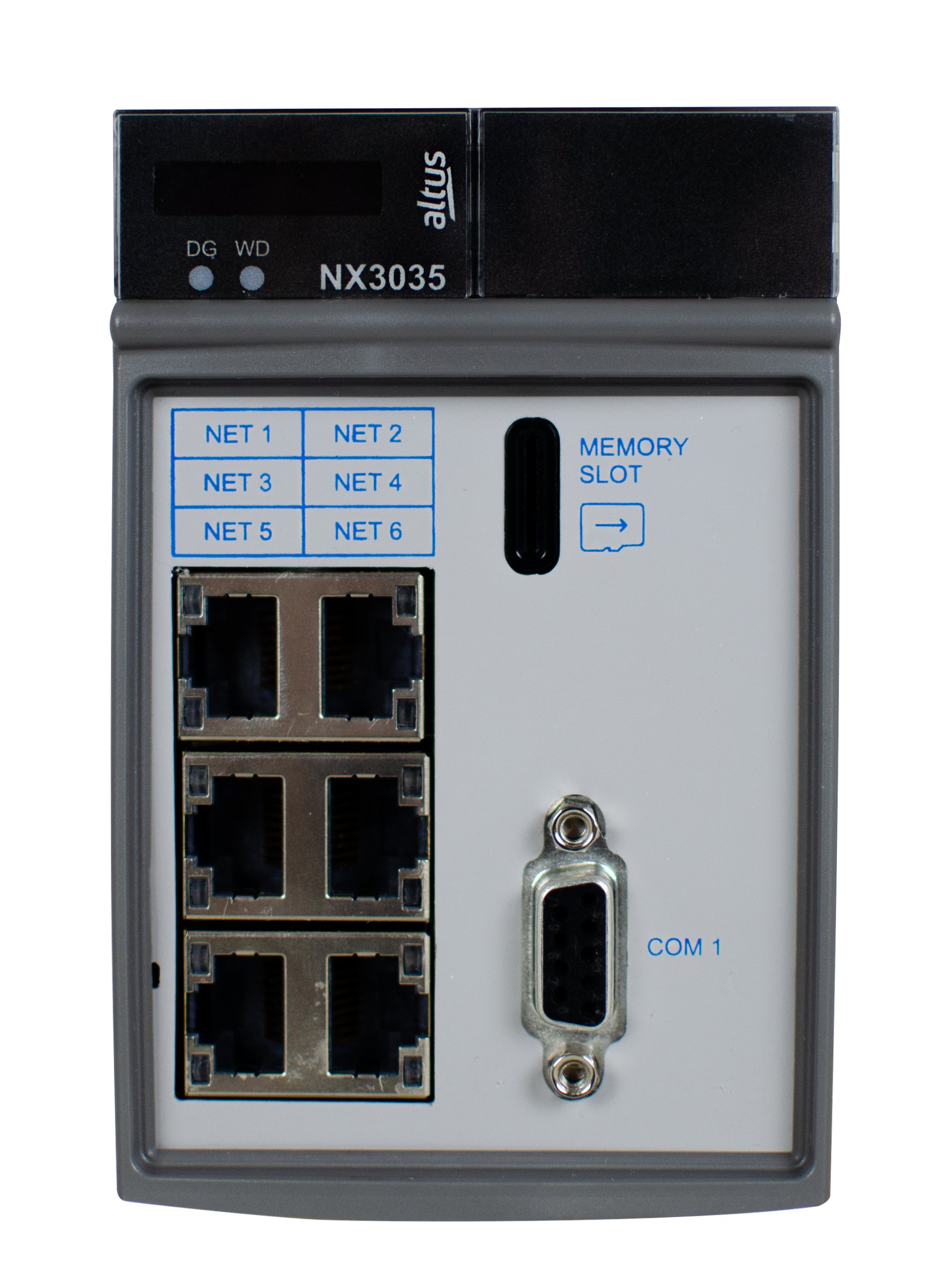
Six Integrated Gigabit Ethernet Interfaces (10/100/1000 Mbps): The NX3035 features six Ethernet communication ports directly on its front panel. This capability allows the separation of the critical deterministic control network from the SCADA supervision network and the remote diagnostics network, shielding the control loop against packet overload, external communication failures, and unauthorized access.
Two Dedicated SFP Ports for Redundant Synchronization: The exclusive ports for SFP optical transceivers operate at 1.25 Gbps and allow the two redundant racks to be physically separated by up to 10 km via single-mode fiber optics. This separation capability ensures that localized incidents, such as explosions, gas leaks, or fires in one room, do not compromise the backup controller, which maintains safe operation from another area.
Expanded Memory with Multiple Block Storage (MBS) Architecture: The CPU supports up to 8 MB of retentive memory, 20 MB of symbolic variables, 2,912 KB of redundant data, and 256 MB of integrated source-code backup. This capacity eliminates the risk of losing operational parameters after failures, removing the need for reprograming, sensor recalibrations, and the costs associated with process startup instability.
Battery-Free Operation (BFO) and High-Stability Real-Time Clock (RTC): Operating without lithium batteries, the hardware retains its retentive memory and keeps the real-time clock synchronized for up to 15 days after complete power de-energization. In remote plants or offshore platforms, this feature prevents the loss of the PLC’s internal logic during prolonged power outages, eliminating the cost and logistics of dispatching specialists for on-site reconfiguration.
Integrated Diagnostics: One Touch Diag (OTD), ETD, and OFD: The graphic display embedded in the CPU shows detailed failure diagnostics directly on the controller panel. In the event of network defects or I/O channel failures, the operator identifies the root cause and the involved tag in seconds. The result is a reduction in the mean time to repair (MTTR) and lower operational stress during critical events.
Double Hardware Width (DHW) and Easy Plug System (EPS) Terminal Blocks: The NX3035 features compact modules with a tool-free front terminal block insertion and removal system. This combination optimizes the use of internal space within panels and accelerates corrective replacements in the field during hot-swapping interventions, keeping downtime to an absolute minimum.
Learn more: NX3035: high-performance redundancy for critical process control
Redundancy as a survival policy in the industrial market
Faced with losses that can exceed R$ 700,000 per hour of downtime and penalties imposed by regulatory bodies, investing in high availability is no longer a technical choice; it has become an operational safety and bottom-line protection policy for modern industries.
Controllers such as the NX3035 CPU deliver the necessary response to this demand, combining high processing performance with native hot-standby bumpless transfer technology via fiber optics. By eliminating systemic losses caused by single hardware failures and ensuring compliance with standards like IEC 61511, NR-13, and ANEEL regulations, a redundant controller acts as an operational, technical, regulatory, and financial shield.
By preventing the first processor failure from halting the production flow, the redundant system pays for itself entirely in less than an hour of continuous operation. What begins as an infrastructure investment quickly turns into a competitive advantage and long-term value generation.
To transform your plant’s risk profile from a vulnerability bottleneck to a reliable, high-availability operation, contact Altus engineering and application experts through the form!