






The new MasterTool update is now available for download!
The history of industrial automation is marked by continuous cycles of technical breakthroughs and the convergence between hardware robustness and software flexibility.
Driven by this history, Altus has consolidated itself as a company capable of transforming complex engineering challenges into integrated solutions for the most critical demands of the industry.
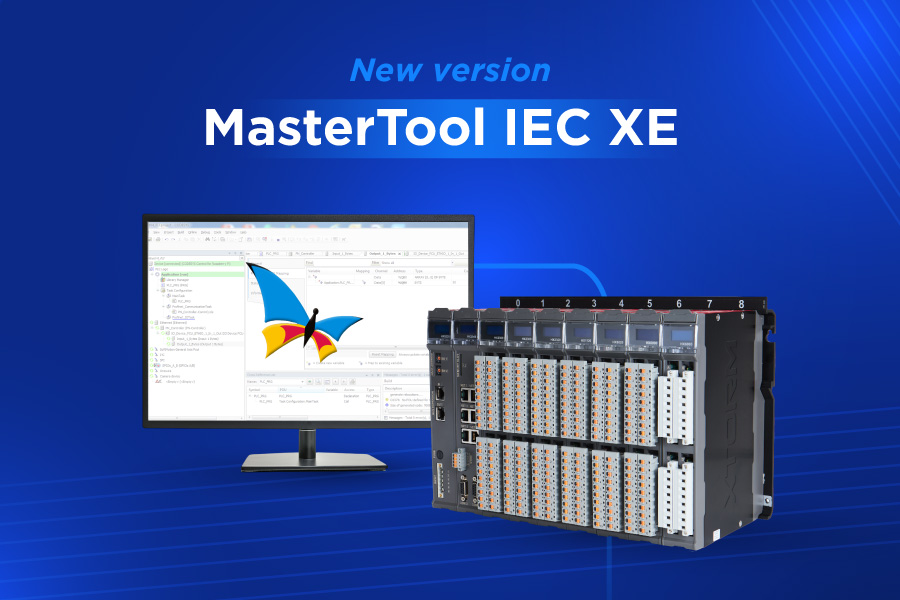
With the launch of the new version of MasterTool IEC XE, we have evolved our main tool by incorporating new features that keep pace with the evolution of modern industrial environments.
This article presents the main highlights of this update, featuring the strategic implementation of the MMS Client protocol and the reinforcement of the controllers’ physical security through access control for USB and SD Card interfaces. Follow along in the next paragraphs.
Nexto HX: the ruggedness the power sector demands
To understand the new functions of version 3.77, one must look at the Nexto HX series (also known as Xtorm). Specifically designed for the severe demands of the electrical energy sector, this series of RTUs combines processing speed with a rugged design, capable of operating in critical environments where electromagnetic interference (EMI) and thermal variations are constant.
By incorporating features typical of Distributed Control Systems (DCS), these RTUs integrate natively with the most widely used SCADA systems on the market. Their backplane architecture enables data sharing between multiple controllers, ensuring precision of up to 1 ms in event logging.
This level of synchronism eliminates communication bottlenecks and ensures the traceability required in large-scale and high-criticality applications, such as substations, power control centers, and complex industrial systems.
The main advancement of this new version of MasterTool IEC XE is the inclusion of the MMS protocol in the Client function for the Nexto HX series. For professionals working under the IEC 61850 standard, the global benchmark in substation automation, this functionality represents a shift in the control hierarchy and architecture, expanding the role of RTUs within power systems.
See the main differentiators of the HX RTUs:
| Feature | Nexto HX | Impact in the application |
| Processing Capacity | Superior with Linux OS | Stability and speed for complex logic |
| Ethernet Ports | Up to 6 ports per CPU | Redundancy and multiple simultaneous communications |
| Event logging | 1 ms event buffer | Precision in audits and network failures |
| I/O Isolation | 2,500 Vdc isolated | Galvanic protection against surges and transients |
| Battery-free operation | High retentivity | Drastic reduction in maintenance at remote locations |
What is MMS and why is the Client function essential?
MMS (an acronym for Manufacturing Message Specification), standardized by ISO 9506, is a client/server-oriented communication protocol for the structured exchange of real-time data between intelligent devices. In the classic context of IEC 61850, RTUs traditionally operated as servers, making information such as electrical measurements, circuit breaker statuses, and alarms available to a SCADA system, which assumed the role of the client.
With the arrival of the MMS Client in version 3.77 of MasterTool, the Nexto HX family takes on an active role in the network. The controllers become capable of querying, acquiring, and also writing data directly to other IEDs (Intelligent Electronic Devices). This evolution allows the solution to function as a local data orchestrator, aggregating information from protection relays, meters, and other intelligent equipment without depending on the mediation of a supervisory system.
Practical benefits of the MMS Client function in the industry
– Local intelligence in substation automation: The RTU can now collect data from different manufacturers, process complex interlocking logic, and command corrective actions in real time, increasing system reliability.
– Reduction in engineering costs: By using self-descriptive tag names via SCL (Substation Configuration Language) files, network configuration becomes intuitive, reducing configuration errors, accelerating commissioning, and lowering the total engineering cost.
– Interoperability and investment protection: Compliance with IEC 61850-8-1 ensures that Altus hardware communicates with any device on the market that follows the same standard, regardless of the manufacturer. This interoperability ensures greater longevity for the system architecture.
Layered Cybersecurity with USB and SD Card blocking
While the MMS Client opens the doors to more connectivity, MasterTool version 3.77 also provides the “keys” to physically lock them. In a scenario marked by the rise of cyberattacks against critical infrastructure, direct access to hardware has become one of the risk vectors requiring the most attention.
In this version, Altus has introduced a new feature: the feature to disable the USB port and SD Card interfaces, both via the web interface and directly through the application logic.
USB ports and SD card slots are extremely useful tools for field applications. They allow for quick firmware updates, the loading of boot projects, and the storage of massive data logs for diagnostics. However, an infected flash drive or the unauthorized removal of an SD card containing the project’s intellectual property could compromise the entire operation.
| Feature | Use | Security risk |
| USB Port (Host) | Firmware updates and project loading | Malware injection or code extraction |
| SD Card | Log backup and memory expansion | Theft of confidential operational data |
The solution in MasterTool 3.77
The new version allows the system administrator to configure the operational status of these interfaces. Through the CPU Settings tab in MasterTool or via the web diagnostics page, it is possible to electronically block the USB ports and the SD card slot, preventing unauthorized access.
The differentiator here lies in the integration with the application logic: the developer can create logic that keeps the USB port disabled by default and only enables it upon the entry of a specific password on an HMI or after the recognition of a secure maintenance condition, ensuring that the hardware is resilient not only to network attacks but also to local intrusions.
This update was designed to support Altus’ commitment to internationalization and the delivery of competitive solutions on a global scale. By adopting the CODESYS platform as our technological base, we ensure that this advancement happens integrated within a worldwide innovation ecosystem, where interoperability and code portability preserve any organization’s most valuable asset: technical knowledge.
Whether in digital substations, power plants, or complex industrial facilities, Altus continues to prove that cutting-edge technology can, and should, be on the global podium of industrial automation.