





Daily routines across manufacturing plants are changing every day, driven by digitalization, asset sensorization, and real-time operational data analysis. Terms like Artificial Intelligence (AI) and Machine Learning have moved beyond IT rooms and R&D labs to become part of everyday operations across a wide range of facilities.
On the factory floor, these technologies already appear in systems capable of anticipating mechanical failures, identifying variations in product quality, optimizing process loops, and detecting abnormal behavior before an unplanned shutdown occurs. However, the rapid spread of these concepts also brings uncertainty.
AI and Machine Learning are frequently treated as synonyms, as if they were the exact same thing. This confusion obscures critical differences that directly impact the success of automation projects where these technologies are applied.
Alongside this shift, the rise of intelligent automation raises questions and concerns regarding the future of human roles in manufacturing. Some fear that analytical software will replace skilled labor. In practice, however, a different scenario emerges: computational intelligence acts as a support tool that amplifies team capabilities. It eliminates repetitive routines and delivers accurate data so that decision-making remains in the hands of those who know the operation best.
What is Artificial Intelligence?
Artificial Intelligence is a broad field of computer science dedicated to developing systems and software capable of simulating abilities associated with human cognition, such as logical reasoning, data interpretation, pattern recognition, and complex problem-solving.
In industry, the goal of AI is not to create self-aware machines, but rather operational tools with analytical autonomy to perform intelligent tasks.
Conventional automation has always relied on pre-programmed deterministic logic, where an engineer must manually anticipate every operating rule and condition, for example, logic dictating that if input A is triggered, output B responds. Artificial Intelligence expands this capability by allowing software to analyze varied operational contexts and adapt its responses according to the situation at hand.
Far from being limited to humanoid robots, flying cars, or distant futuristic systems, AI is already embedded in everyday tools on the factory floor:
Computer vision systems: Algorithms process images captured by high-resolution cameras to inspect components on the assembly line, identifying cracked parts, dimensional deviations, or paint defects within milliseconds.
Decision-support software: These tools analyze thermal, pressure, and flow data to recommend optimal parameter adjustments to operators, maximizing process efficiency.
Anomaly detection systems: Software continuously monitors production line behavior and flags any deviation from expected operating conditions.
Technical virtual assistants: Intelligent interfaces help maintenance teams quickly look up manuals, electrical schematics, and operating procedures directly on tablets or mobile devices.
AI brings together diverse problem-solving methodologies, ranging from rule-based expert systems to advanced statistical learning algorithms. Even so, it does not replace functions that depend on human judgment.
What is Machine Learning?
Machine Learning is a specific subfield of Artificial Intelligence focused on developing algorithms that learn to identify patterns from historical data without requiring explicit code instructions for every scenario.
In traditional programming, an automation engineer writes out all the operating rules. In Machine Learning, the algorithm analyzes large volumes of process data and autonomously extracts the statistical relationships between variables. During training, the system builds its own behavioral model from the examples provided.
To see how Machine Learning works in an industrial setting, consider the monitoring of a motor-pump unit equipped with temperature, electrical current, and vibration sensors:
Operational history collection: Sensors continuously record motor operation over weeks of normal running conditions.
Pattern learning: The Machine Learning algorithm analyzes this historical data and learns the typical vibration and temperature profile for each load and motor speed condition, establishing a “baseline” for healthy equipment.
Deviation identification: Suppose the motor begins showing a subtle shift in vibration combined with a slight temperature increase. Even if the readings are still below traditional alarm thresholds, the model recognizes that the behavior deviates from the learned pattern and flags potential mechanical looseness or premature bearing wear.
Despite its effectiveness, Machine Learning is not infallible. A model’s performance directly depends on the quality, cleanliness, and representativeness of the collected data. Incomplete or noisy data leads to inaccurate diagnostics, making human oversight and technical validation essential to process reliability.
What is the difference between Artificial Intelligence and Machine Learning?
The relationship between Artificial Intelligence and Machine Learning is one of hierarchy and inclusion.
AI is the broad field encompassing all technologies aimed at performing intelligent tasks. Machine Learning is one of the methodologies within that field, where learning is driven by data.
Every Machine Learning algorithm is a form of Artificial Intelligence, but not every AI application uses Machine Learning. An example is an expert system that makes decisions based on a complex tree of fixed rules created by an engineer. It is AI, yet it is not Machine Learning because it does not learn autonomously from data. Explore the differences in detail:
| Comparison criterion | Artificial Intelligence | Machine Learning |
| Definition and scope | Broad concept involving machines performing intelligent tasks. | Subfield of AI focused on algorithms that learn patterns directly from data. |
| Origin of rules | Can be based on static rules pre-programmed by humans or on automated learning. | Rules and patterns are autonomously extracted from historical data. |
| Data dependency | Can operate using structured deterministic logic, without requiring historical data. | Strictly requires representative, high-quality volumes of data for training. |
| Flexibility and adaptation | Fixed-rule systems require manual reprogramming to alter behaviors. | Adapts its statistical model when “retrained” with new operational data. |
| Practical example | Software that halts a conveyor based on a fixed combination of 10 logic interlocks. | A model that predicts the exact time to replace a machining tool by analyzing vibration. |
In modern industry, these two technologies typically work in an integrated manner. For example, an intelligent process control system might use Machine Learning to identify trends in operational data and rely on AI logic to structure the alerts displayed on the operator interface.
How can these technologies be applied in everyday industrial operations?
The practical application of AI and Machine Learning aims to solve productivity, machine availability, and quality challenges on the factory floor, including:
Predictive maintenance: Rather than relying on fixed-interval overhauls or emergency repairs after a breakdown, Machine Learning-driven predictive maintenance analyzes continuous sensor data (temperature, vibration, pressure, and electrical current) to detect the earliest signs of component degradation. This makes it possible to schedule maintenance before a major failure occurs, preventing unplanned downtime and optimizing spare parts inventory.
Automated quality control: Using computer vision systems paired with learning algorithms, production lines can inspect 100% of manufactured items. AI verifies dimensions, identifies cracks, evaluates surface finishes, and detects assembly defects at high speed. The result is reduced raw material scrap and greater batch consistency.
Machine and process monitoring: Analytical software tracks real-time operational telemetry to detect micro-stoppages, flow bottlenecks, and control loop deviations. By correlating variables across different production stages, the system helps operators maintain process stability and maximize Overall Equipment Effectiveness (OEE).
Industrial safety: Computer vision applied to workplace safety monitors restricted or high-risk areas. The system verifies proper PPE usage, flags unauthorized entry into hazard zones around robotic cells, and alerts personnel to unsafe environmental conditions.
Energy efficiency and operational optimization: Machine Learning models analyze electricity, gas, and compressed air consumption profiles alongside production rates and energy tariff schedules. Based on this data, the system recommends the optimal operating schedule for high-consumption utilities such as compressors and chillers, reducing waste and cutting operating costs without compromising production targets.
Will Artificial Intelligence replace industrial professionals?
One of the topics generating the greatest concern across manufacturing sectors is the fear that advanced automation and AI will eliminate jobs on the factory floor.
A realistic look at how these technologies are applied, however, shows that automating data-processing stages does not mean replacing people.
Machine Learning algorithms excel at calculating statistical correlations and processing thousands of measurements per second. Yet they lack contextual awareness, technical intuition, critical judgment, and the physical ability to intervene on a machine. Intelligent tools serve as support systems that expand human analytical capabilities:
In maintenance: A Machine Learning system can flag a shift in the vibration signature of an industrial pump, while the maintenance technician conducts the on-site inspection, determines whether the issue stems from misalignment or insufficient lubrication, and decides on the appropriate corrective action.
In operations: Software can highlight a drifting trend in product quality, while the operator applies practical process knowledge to adjust machine variables and correct the fluctuation.
In engineering: AI-generated analytical reports provide diagnostics that allow multidisciplinary teams to spend less time hunting for data and more time planning improvements.
Adopting these technologies transforms how tasks are performed by cutting down repetitive effort and manual routines. In this new landscape, skills such as data interpretation, a systemic view of the process, and problem-solving become even more critical, turning technology into an ally for the workforce.
The relation between Docker, Machine Learning, and Edge Computing
Edge Computing is an architecture in which data processing takes place right where the information is generated, on the factory floor, rather than sending all raw data to cloud servers or data centers.
Running Machine Learning models in Docker containers deployed on edge devices enables full real-time analytics. Model training, which demands high processing power, can be performed externally. Once trained, the lightweight model is packaged into a container and executed directly on the PLC.
This approach ensures low latency when issuing alerts, reduces internet bandwidth requirements, and preserves operational autonomy even during network fluctuations or loss of external connectivity. It is worth clarifying, however, that Docker is not an AI tool in itself; rather, it is the enabling technology that streamlines the execution and management of analytical applications.
Machine Learning on the factory floor: how Docker on a PLC can be an ally
For Machine Learning applications to generate real value, analytical models must run close to the machines. This ensures rapid response times without relying on a continuous cloud connection. Combining container virtualization, Edge Computing, and PLCs makes this integration possible.
Docker is an operating-system-level virtualization technology that allows an application and all of its dependencies, such as code libraries, configurations, and executables, to be packaged into an isolated environment called a container.
A container functions like a sealed software box. Instead of installing programming languages and analytical libraries directly onto the device’s main operating system, which could introduce instability, the application runs in isolation inside the container. This brings practical advantages:
Isolation: Running the application inside a container does not interfere with the device’s primary control functions.
Portability: Software developed on a test computer behaves in the exact same way when deployed to the machine controller.
Simplified maintenance: Updating or replacing a data analytics application simply requires swapping out the container image, without interrupting the control firmware.
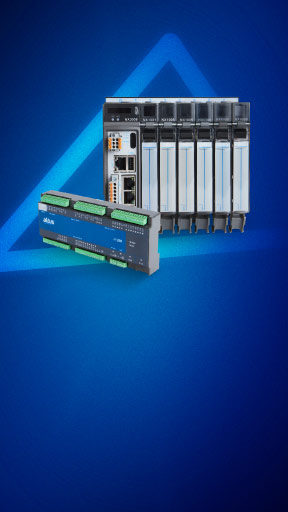
At Altus, the Nexto XF Series can be deployed as a distributed intelligence platform. These controllers combine the real-time control capabilities of a deterministic PLC with Edge Computing features and virtualization support.
The Nexto XF architecture follows a clear premise of cybersecurity and reliability. Real-time control loops, safety interlocks, and machine commands continue to execute deterministically within the CODESYS control runtime. Meanwhile, the Machine Learning application runs isolated inside a Docker container, reading process variables exposed by the PLC via OPC UA or MQTT protocols and returning diagnostics or tuning recommendations. Even if the container stops, the machine continues operating safely under the PLC’s control.
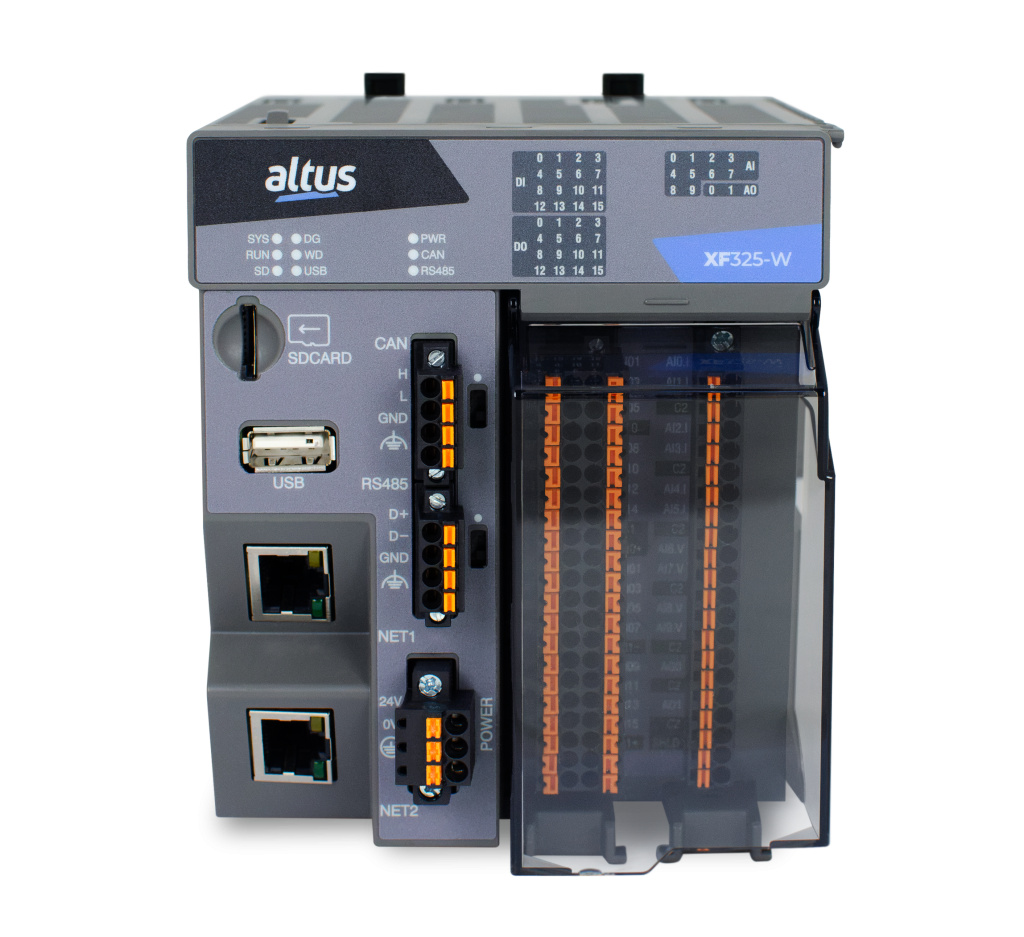
To illustrate the integration between the Nexto XF controller, Docker, and Machine Learning, consider a predictive health monitoring application for industrial motors:
Sensorization and data collection: Sensors mounted on the electric motor measure physical operating variables such as triaxial vibration, current draw, and temperature.
PLC processing: The Nexto XF controller acquires these readings through its analog I/O modules or over a Modbus industrial network. The control runtime manages motor operation and makes the acquired measurements available in memory.
Internal communication: Using the OPC UA protocol or the integrated MQTT broker (Mosquitto) on the controller, process variables are securely passed to the containerized environment.
Containerized Machine Learning: A Docker container runs a lightweight predictive model written in Python with the ONNX Runtime library, receiving the data in real time. The model compares instantaneous measurements against the learned behavioral curve and calculates a “Motor Health Index.”
Team alerts: If a developing anomaly is detected, the ML application sends an alert message via MQTT to the SCADA system or directly to the maintenance team’s mobile devices, while also updating the status indicator on the PLC’s WebVisu screen. With this diagnostic data in hand, the team can plan the appropriate intervention.
This scenario demonstrates how data and predictive analytics can be integrated right at the edge, while highlighting that building the specific containerized analytical application still relies on the expertise of the engineer behind the controller.
Understanding the differences between Artificial Intelligence and Machine Learning is the first step toward applying these technologies effectively in a manufacturing environment. These digital tools do not arrive on the factory floor to compete with automation, operations, and maintenance professionals, but rather to amplify their capabilities.
With solutions like Altus’s Nexto XF Series PLCs, edge computing and Docker virtualization are brought directly into the electrical panel. By integrating deterministic control with distributed intelligence, industries move toward a more predictable, safer, and more productive operational model, one where technology and human experience work together to keep the plant running.